2026-05-04 ノースカロライナ州立大学(NC State)
<関連情報>
- https://news.ncsu.edu/2026/05/heres-why-your-face-doesnt-perceive-itchiness-the-same-way-your-body-does/
- https://www.nature.com/articles/s42003-026-10128-9
サブスタンスPとソマトスタチンニューロンは、脳幹内の異なる侵害受容回路を活性化することで顔のかゆみを抑制する Substance P and somatostatin neurons limit facial itch by recruiting distinct nociceptive circuits in the brainstem
Joshua J. Wheeler,Nidha Williams,Aditi Vigneshwar,B. Duncan X. Lascelles,Thierry Olivry & Santosh K. Mishra
Communications Biology Published:02 May 2026
DOI:https://doi.org/10.1038/s42003-026-10128-9 Unedited version
Abstract
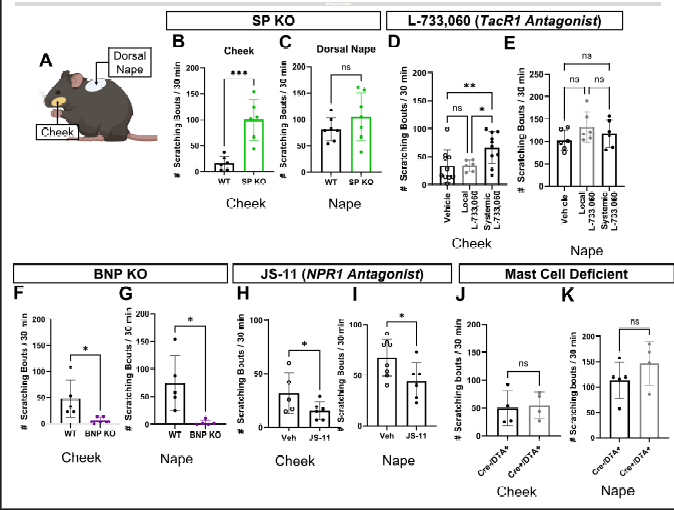
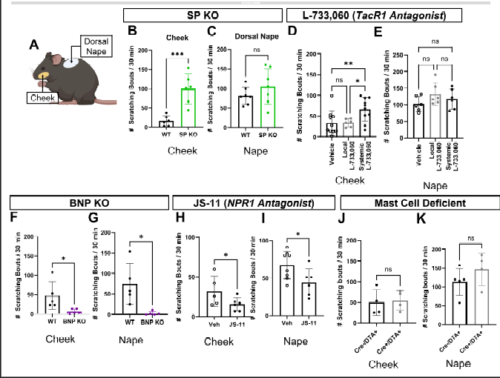
Itch is a complex noxious sensation associated with many skin and systemic conditions, which varies in intensity and quality across different body regions. Despite its prevalence, the molecular and cellular mechanisms underlying regional itch differences remain poorly understood. Investigating the neural basis of regional itch differences, we identified a functional divergence in neuropeptide signaling and central circuit engagement between the trigeminal and spinal systems, which was independent of peripheral innervation density. Utilizing a combination of behavioral, pharmacological, genetic, and molecular assays, we identified a unique population of trigeminal (TG) neurons that facilitate specialized itch-pain coding. Our results indicate that while histamine receptors HRH1 and HRH3 are both involved in mediating mixed itch-and-pain sensations, the specific activity of Substance P (SP)- and Somatostatin (SST)-expressing neurons orchestrates this transition in the cheek. This behavioral shift is mediated by a central mechanism wherein sensory neurons activation recruits distinct nociceptive circuits within the brainstem. In brief, these findings provide insights into the molecular and cellular mechanisms underlying regional itch differences, highlighting the importance of considering anatomical location when developing targeted treatments.