2026-05-04 ワシントン州立大学(WSU)
<関連情報>
- https://news.wsu.edu/press-release/2026/05/04/the-big-bang-of-plant-life-discovery-sheds-light-on-how-cells-form-walls/
- https://www.science.org/doi/10.1126/sciadv.aea8387
IMK2-IMK3モジュールは、シロイヌナズナにおける新生細胞壁の生合成と細胞分裂後の分化を制御する IMK2-IMK3 module regulates biogenesis of nascent cell walls and postcytokinetic differentiation in Arabidopsis thaliana
Tetyana Smertenko, Deirdre Fahy, Glenn Turner, and Andrei Smertenko
Science Advances Published:1 May 2026
DOI:https://doi.org/10.1126/sciadv.aea8387
Abstract
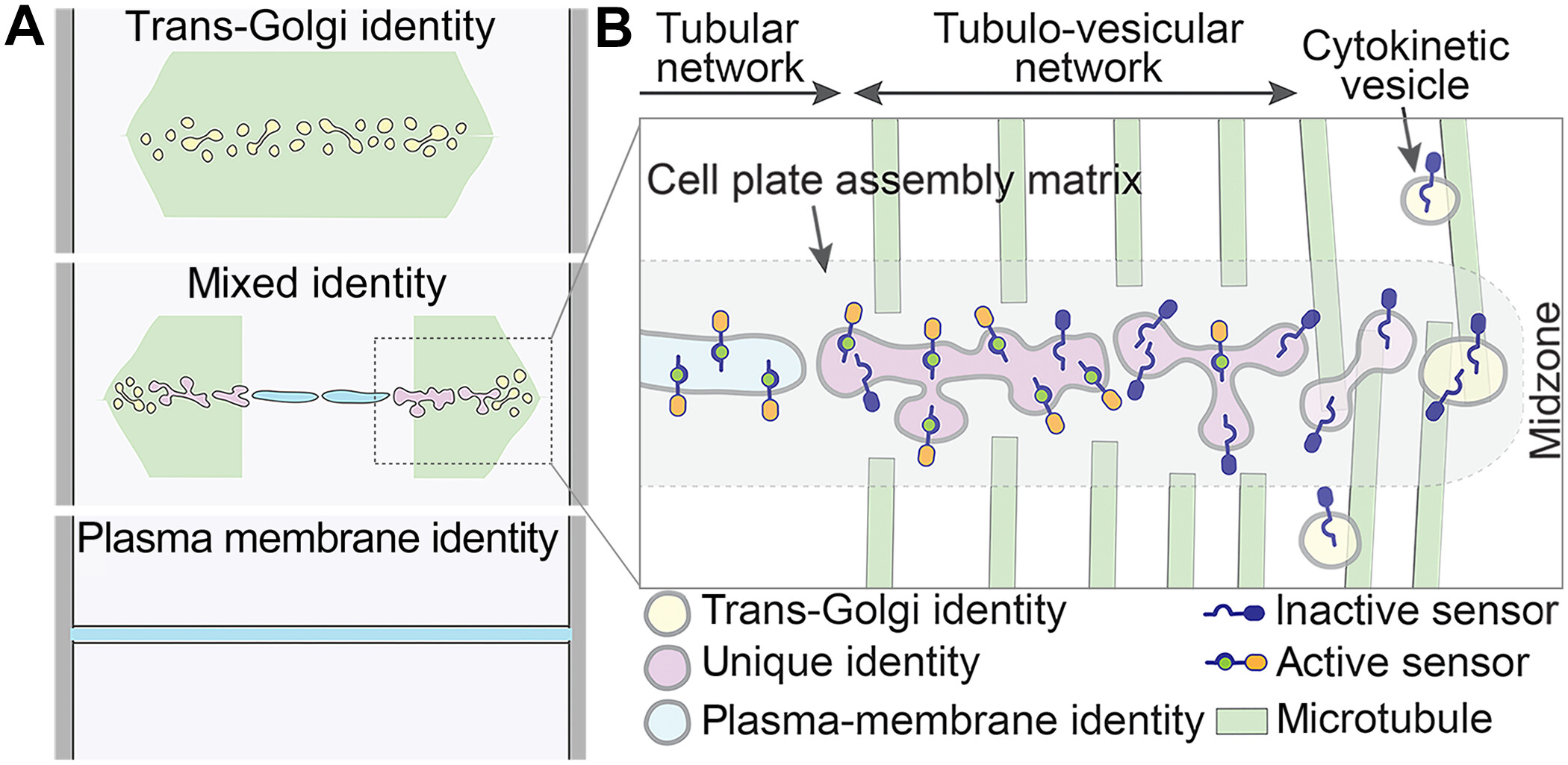
Cell walls in land plants originate during cytokinesis from a membrane compartment called the cell plate. Arising as the trans-Golgi compartment, cell plates acquire a unique molecular identity of lipids and proteins, associate with microtubules, and accumulate polysaccharides within its lumen. Polysaccharide deposition triggers microtubule depolymerization and initiates a cell plate transition toward a plasma-membrane identity. However, how cells monitor cell plate biogenesis and coordinate it with microtubule behavior remains unknown. Here, we identify a multifunctional signaling module composed of the receptor-like kinases IMK2 and IMK3 that operates during cell division and early differentiation. The IMK2-IMK3 module coordinates TRAPPII- and exocyst-dependent vesicle trafficking, the antiparallel architecture and stabilization of microtubules, and the synthesis of the polysaccharide callose. In addition, this module couples postcytokinetic cell elongation with the onset of differentiation. Together, these findings uncover a core component of the signaling continuum in the root apical meristem that integrates cell division, differentiation, and organ size.