2026-05-19 中国科学院(CAS)
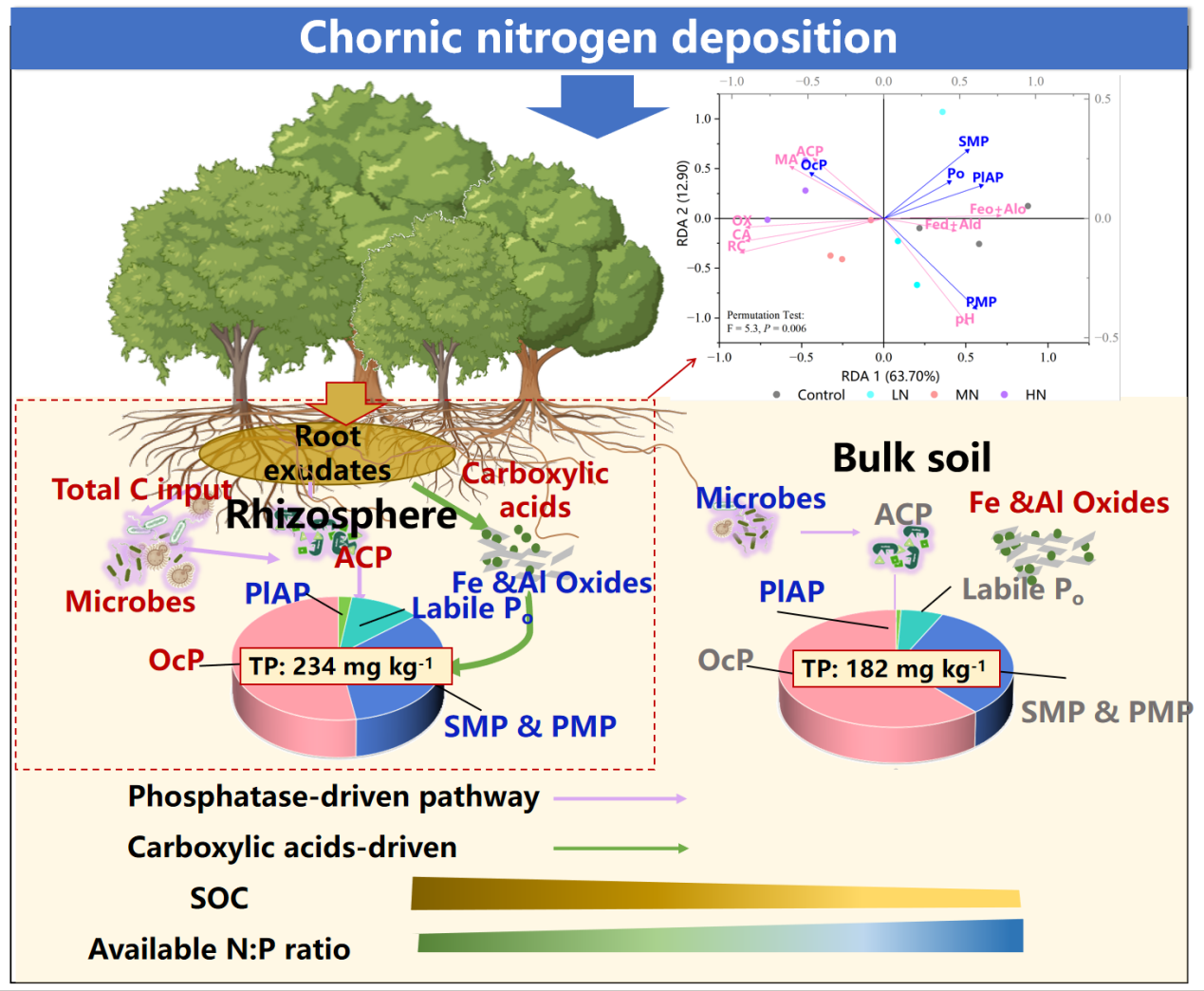
A theoretical framework for long-term N deposition promoting root exudation and rhizosphere P cycling in primary tropical forests. (Image by ZHU et al.)
<関連情報>
- https://english.cas.cn/newsroom/research-news/202605/t20260519_1159610.shtml
- https://onlinelibrary.wiley.com/doi/10.1111/gcb.70912
慢性的な窒素沈着下における熱帯原生林でのリン動員を促進する適応メカニズムとしての根からの分泌物の増強 Enhanced Root Exudation as an Adaptation Mechanism to Facilitate Phosphorus Mobilization in a Primary Tropical Forest Under Chronic Nitrogen Deposition
Xiaomin Zhu, Ziliang Zhang, Benjamin L. Turner, Weibin Chen, Qinggong Mao, Andi Li, Jiangming Mo, Xiankai Lu
Global Change Biology Published: 15 May 2026
DOI:https://doi.org/10.1111/gcb.70912
ABSTRACT
Tropical and subtropical forests play a key role in alleviating global climate change by maintaining high ecosystem productivity and carbon (C) sequestration. Elevated atmospheric nitrogen (N) deposition is reshaping ecosystem structure and function in the tropics, yet it remains unclear how N-rich tropical and subtropical ecosystems adapt to chronic N deposition. Using a two-decade N addition experimental platform in a primary tropical forest, we quantified the responses of root exudation and soil P transformation processes. We find that N addition stimulates forest trees to allocate more photosynthates to root exudation and accelerated rhizosphere P mobilization. This finding challenges the paradigm that long-term N addition reduces belowground C allocation. This process represents a critical adaptation mechanism by which trees mitigate decreased P availability induced by long-term N deposition. This study reveals a positive feedback between root exudation and soil P mobilization, supporting high ecosystem C sequestration in N-rich ecosystems under long-term N deposition.