2026-06-05 東北大学
◆これまでレセプトデータを用いて現在歯数を推定する手法は存在したが、義歯の使用有無を把握する方法は確立されていなかった。研究では、65歳以上の高齢者4,053人を対象に、高齢者歯科健診データと歯科レセプトデータを照合し、義歯関連の傷病名コード(義歯不適合、義歯破損など)と診療行為コード(有床義歯修理、歯科口腔リハビリテーション料など)の組み合わせを分析した。その結果、義歯関連の傷病名コードと診療行為コードの併用、または歯科口腔リハビリテーション料の情報を用いることで、義歯使用の有無を高精度に推定できることが判明した。構築したアルゴリズムは感度65.3%、特異度96.6%を示した。
◆本成果により、大規模レセプトデータを活用した高齢者の口腔機能や健康状態に関する疫学研究が進展し、義歯使用と全身健康との関連解明や保健医療政策への応用が期待される。
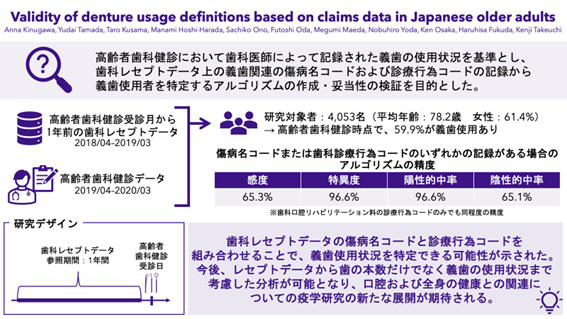
図1. 本研究の概要
<関連情報>
- https://www.tohoku.ac.jp/japanese/2026/06/press20260605-02-denture.html
- https://journals.sagepub.com/doi/10.1177/23800844261444341
日本人高齢者における保険請求データに基づく義歯使用定義の妥当性 Validity of Denture Usage Definitions Based on Claims Data in Japanese Older Adults
A. Kinugawa, Y. Tamada, […], and K. Takeuchi
JDR Clinical & Translational Research Published:May 21, 2026
DOI:https://doi.org/10.1177/23800844261444341
Abstract
Background:
Administrative claims data are increasingly used in oral health research, but their validity for identifying denture use has not been established.
Objective:
To evaluate the accuracy of algorithms based on dental claims codes for identifying denture users, dentist-reported oral health screening records were used as the reference standard.
Methods:
We analyzed data from 4,053 adults aged ≥65 y in the Longevity Improvement and Fair Evidence (LIFE) Study in Japan. Twelve algorithms incorporating 56 denture-related diagnosis and procedure codes were developed from claims in the 12 mo preceding the screening. Sensitivity, specificity, positive predictive value (PPV), and negative predictive value (NPV) were calculated. Sensitivity analyses used a 6-mo claims window. A post hoc bias analysis was also performed.
Results:
During screening, 59.9% of the participants were classified as denture users. Algorithms based solely on diagnosis codes showed very high specificity (98.3%–100%) but low sensitivity (1.4%–20.8%). Among the procedure-based definitions, oral rehabilitation codes (algorithm f; denture adjustment or instruction) had the highest sensitivity (63.6%). The combined algorithm using both diagnosis and procedure codes (algorithm C) achieved the best balance, with 65.3% sensitivity, 96.6% specificity, 96.6% PPV, and 65.1% NPV. Similar findings were observed using the 6-mo claims data. Bias analysis indicated that the risks for denture use could be underestimated by 26% to 59%, with algorithm C showing the least bias.
Conclusions:
Denture use can be identified from dental claims data with moderate accuracy. Algorithms combining denture-related diagnosis and procedure codes or using oral rehabilitation codes provide practical definitions for research on oral and systemic health outcomes.
Knowledge Transfer Statement:
The result of this validated study can be identified as denture use from dental claims with moderate accuracy. In combination with validated denture use and the number of remaining teeth, it can expand opportunities to assess oral health status and its relationship with systemic health outcomes in large-scale epidemiologic studies using claims data.