2026-06-04 大阪大学
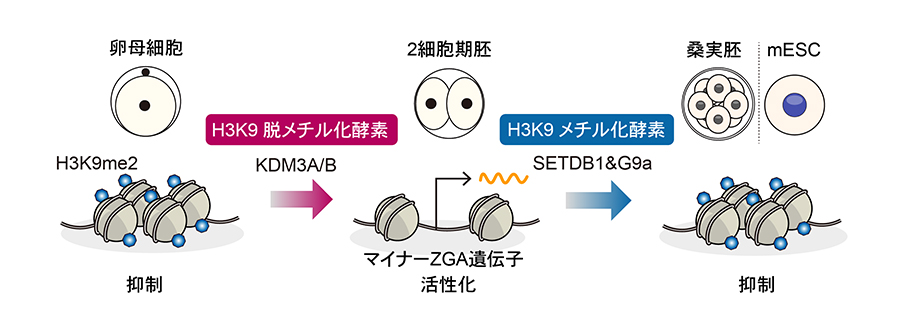
図1. H3K9me2の動的変化によるマイナーZGA遺伝子の制御
<関連情報>
- https://www.fbs.osaka-u.ac.jp/ja/research_results/papers/detail/1117
- https://www.nature.com/articles/s41594-026-01811-w
H3K9ジメチル化の動的な制御がマウスのマイナー接合子ゲノムの活性化を促進する Dynamic regulation of H3K9 dimethylation drives mouse minor zygotic genome activation
Ryo Maeda,Shunsuke Kuroki,Hiromi Shimojo,Masahiro Nagano,Masahiro Matsuwaka,Hiroshi Sasaki,Azusa Inoue & Makoto Tachibana
Nature Structural & Molecular Biology Published:26 May 2026
DOI:https://doi.org/10.1038/s41594-026-01811-w
Abstract
Minor zygotic genome activation (ZGA) is crucial for early development and totipotency acquisition; however, the regulatory mechanisms controlling minor ZGA gene expression remain elusive. Here, we show that mouse minor ZGA is driven by spatiotemporally dynamic regulation of H3K9 dimethylation (H3K9me2). H3K9me2 levels at the minor ZGA gene loci are reduced at the early two-cell stage and are reestablished by the morula stage. Maternal depletion of the H3K9 demethylases KDM3A and KDM3B leads to increased H3K9me2 levels and impaired minor ZGA at the early two-cell, followed by arrest at the two-cell to four-cell stage. In mouse embryonic stem cells, H3K9 at the minor ZGA loci is dimethylated. Combined loss of the H3K9 methyltransferases G9a and SETDB1 results in the synergistic derepression of minor ZGA genes. Mechanistically, SETDB1 targets the transcriptional factor Dux, while G9a broadly represses minor ZGA genes through H3K9me2 deposition linked to lamina-associated heterochromatin formation. Therefore, H3K9me2 dynamics are unveiled as an important regulator of minor ZGA, highlighting the indispensable role of epigenetic control in early embryogenesis.