
2026-07-01 カリフォルニア大学サンディエゴ校(UCSD)
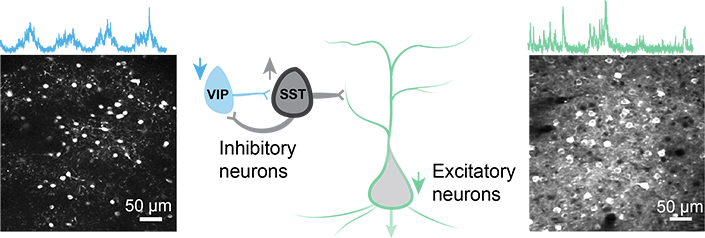
The activity of neuron types in the brain is imbalanced in mice with Huntington’s disease. Credit: Sonja Blumenstock, Komiyama Lab, UC San Diego
<関連情報>
- https://today.ucsd.edu/story/neurobiologists-improve-symptoms-of-huntingtons-disease-with-targeted-brain-stimulation-in-mice
- https://www.nature.com/articles/s41586-026-10671-9
皮質抑制解除の回復はハンチントン病の表現型を改善する Restoring cortical disinhibition improves Huntington’s disease phenotypes
Sonja Blumenstock,David Arakelyan,Nicholas del Grosso,Sonja Schneider,Yufeng Shao,Enida Gjoni,Rüdiger Klein,Irina Dudanova & Takaki Komiyama
Nature Published:01 July 2026
DOI:https://doi.org/10.1038/s41586-026-10671-9
Abstract
Huntington’s disease (HD) is a devastating movement disorder without a cure at present1. Although the monogenic basis of HD is well defined2, the complex downstream effects that underlie behavioural symptoms are poorly understood. These effects include cortical dysfunction3,4, yet the roles of specific cortical neuronal subtypes in HD symptoms remain largely unexplored. Here we used longitudinal in vivo two-photon calcium imaging to examine the activity of three cortical inhibitory neuron (IN) subtypes and excitatory corticostriatal (CStr) projection neurons in the motor cortex of the transgenic R6/2 HD mouse model throughout disease progression. We found that motor deficits in R6/2 mice were accompanied by neuron subtype-specific abnormalities in movement-related activity. This included marked hypoactivity of vasoactive intestinal peptide (VIP)-INs and CStr neurons, which was also observed in the knock-in zQ175DN HD mouse model. Optogenetic activation of VIP-INs in R6/2 mice restored healthy levels of activity in VIP-INs and their downstream CStr neurons and ameliorated motor deficits in R6/2 mice; behavioural improvements persisted for days after stimulation. Our findings highlight cortical INs as a potential therapeutic target for HD.

