2026-07-10 愛媛大学
<関連情報>
- https://www.ehime-u.ac.jp/data_relese/pr_20260710_med/
- https://www.cell.com/cell-chemical-biology/fulltext/S2451-9456(26)00202-3
RRNAを足場とする核内コンデンセートが神経超長鎖遺伝子発現を統合的に制御 する仕組みを解明-神経疾患につながる新たな分子機構を示唆- NA-dependent SFPQ condensates coordinate multidimensional regulation of extra-long neuronal genes
Motoyasu Hosokawa ∙ Ryosuke Kawakami ∙ Koshi Imami ∙ … ∙ Takeshi Imamura ∙ Masatoshi Hagiwara ∙ Akihide Takeuchi
Cell Chemical Biology Published:July 9, 2026
DOI:https://doi.org/10.1016/j.chembiol.2026.06.004
Highlights
- SFPQ-focused BioID reveals transcriptional elongation condensates on extra-long genes
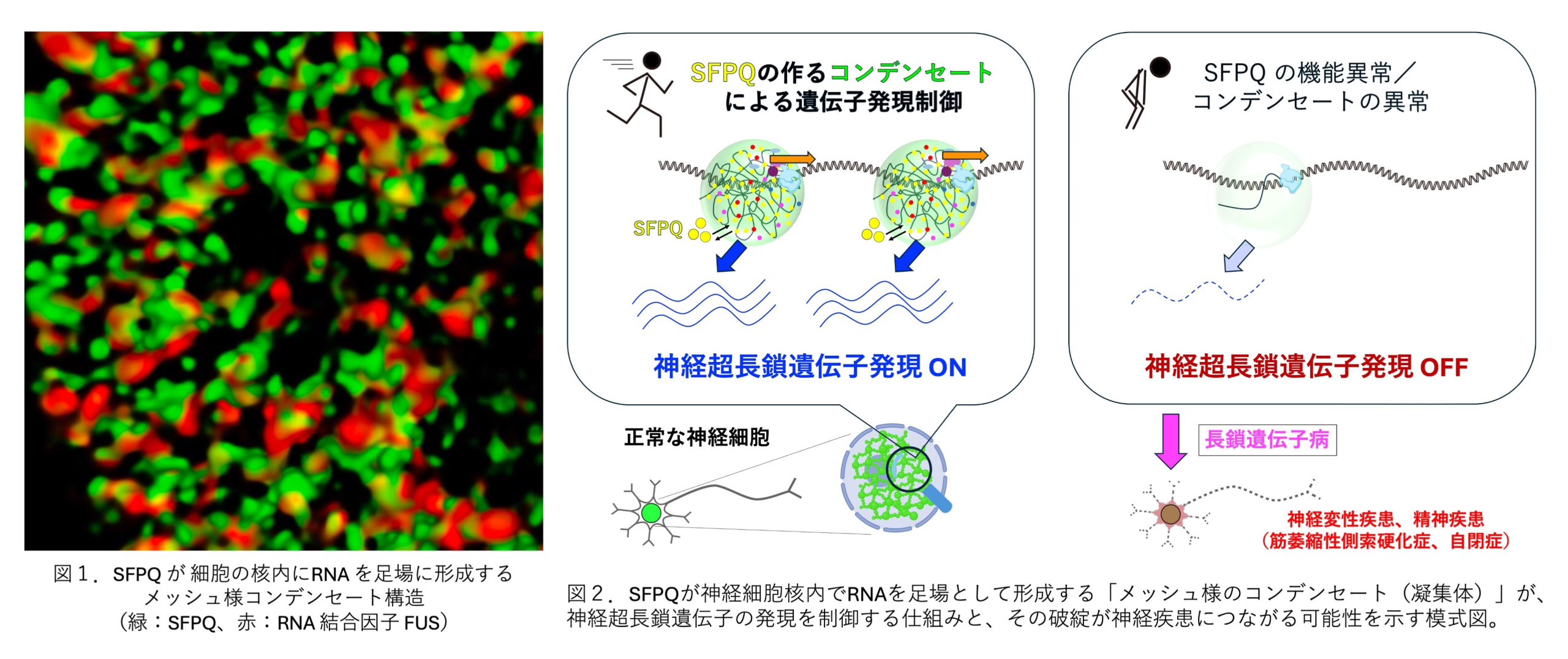
- SFPQ forms RNA-dependent meshwork-like nuclear condensates via phase separation
- SFPQ condensates coordinate splicing, elongation, and chromatin regulation
- Multi-dimensional SFPQ complexes link long-gene transcriptopathy to neuronal disease
Summary
The mammalian brain uniquely expresses a large repertoire of extra-long genes critical for neuronal development and function, yet these transcripts are particularly vulnerable to dysregulation linked to neurological disorders, such as autism spectrum disorder and amyotrophic lateral sclerosis. The molecular mechanisms that ensure their stable expression remain poorly understood. Here, we show that the RNA-binding protein SFPQ forms meshwork-like biomolecular condensates that scaffold a multidimensional gene regulatory complex essential for long-gene expression. Super-resolution microscopy and functional perturbation assays demonstrate that disruption of SFPQ condensates impairs both extra-long gene expression and splicing. Proximity-dependent biotin labeling combined with mass spectrometry (BioID-MS) reveals that SFPQ condensates recruit transcriptional elongation factors, splicing regulators, and chromatin remodelers. Notably, many of these interactors overlap with autism-associated genes, suggesting direct disease relevance. These findings define a higher-order nuclear architecture organized by SFPQ and provide mechanistic insight into long-gene transcriptopathies underlying neurological disorders.