2026-07-14 九州大学
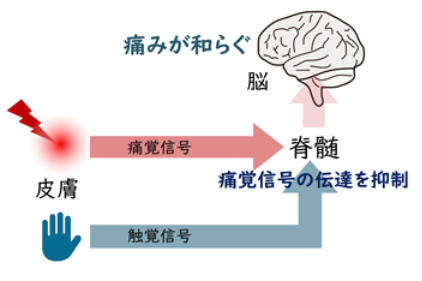
九州大学大学院薬学研究院・高等研究院の津田誠教授らは、「痛いところをさすると痛みが和らぐ」という身近な現象の神経メカニズムを解明し、痛みを抑制する特定の**触覚神経**を世界で初めて特定した。マウスを用いた実験では、この触覚神経を除去すると、痛みを受けた部位を舐め続ける時間が長くなり、逆に神経を選択的に刺激すると、皮膚で生じた痛覚信号が脊髄で抑制され、痛み関連行動が減少した。これにより、触覚神経からの信号が脊髄で痛覚伝達を抑え、「痛いところをさする」「舐める」といった行動による鎮痛効果を生み出すことが示された。本研究は、「痛いの痛いの飛んでけ」や「手当て」の科学的根拠を示す成果であり、薬剤に依存しない触覚刺激を利用した疼痛治療や医療機器の開発につながることが期待される。研究成果は**PNAS**に掲載された。
<関連情報>
マウスにおいて、一次求心性感覚ニューロンの集団が、痛覚回避行動を通じて痛みの緩和を媒介している A population of primary afferent sensory neurons mediates pain relief through nocifensive coping behavior in mice
Daichi Sueto, Sawako Uchiyama, Teruaki Ono, Moeka Watanabe, Misuzu Sekine, Yuto Nishida, Kohei Nomaki, Yuto Shibata, Ryoichi Tashima, Kazuki Fujimori, Yasuharu Nakashima, Makoto Tsuda
Proceedings of the National Academy Sciences Published: July 15, 2026
DOI:https://doi.org/10.1073/pnas.2601766123
Abstract
When exposed to noxious cutaneous stimuli, animals exhibit nocifensive behaviors, including rapid defensive reflexes that limit tissue damage and subsequent coping behaviors—most commonly licking of the affected area—that alleviate pain. Despite its ubiquity, the neural mechanism underlying pain relief through licking remains poorly understood. Here, we demonstrate that Npy2r-Cre+ primary sensory neurons in the dorsal root ganglion (DRG), a population of Aβ fibers that includes touch-sensitive, rapidly adapting low-threshold mechanoreceptors, are critical for this process. Mice lacking Npy2r-Cre+ neurons exhibited a significant prolongation of coping behavior duration, but not bout frequency, following intraplantar injection of capsaicin or formalin. Conversely, optogenetic activation of Npy2r-Cre+ neurons produced attenuating effects on irritant-induced pain. Electrophysiological analyses revealed that Npy2r-Cre+ neurons form functional synaptic connections with neurons in the substantia gelatinosa of the spinal dorsal horn (SDH) and that their activation suppressed C fiber-evoked excitation of neurons in lamina I of the SDH, a region implicated in nociceptive transmission to the brain. Together, these findings identify Npy2r-Cre+ DRG neurons as a key neural substrate for gating nociceptive transmission in the SDH and mediating pain relief through coping behaviors.