2026-07-21 東北大学
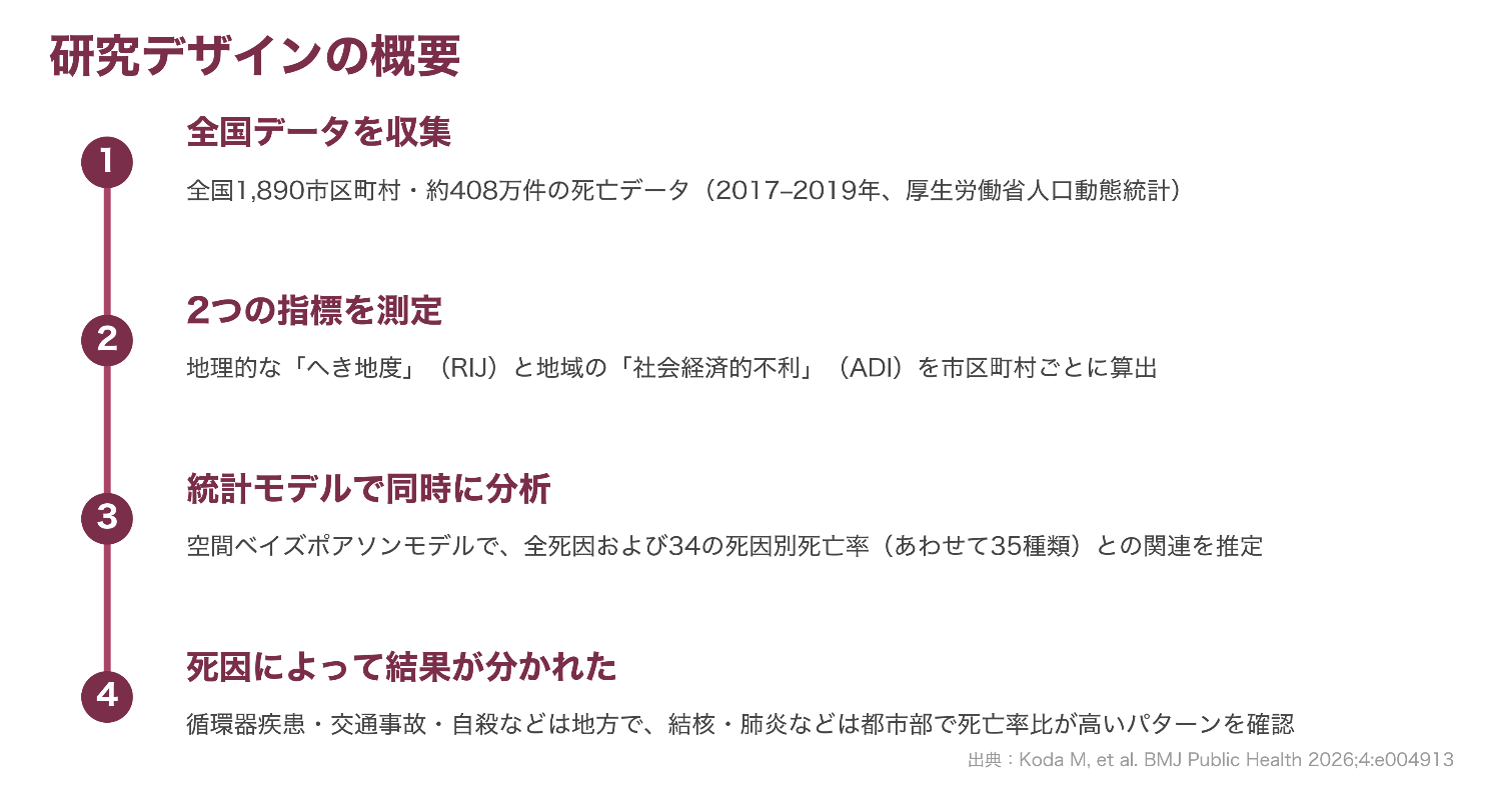
図1. 研究デザインの概要 全国約408万件の死亡データを、「へき地度」と「地域の社会経済的な不利」の2つの視点から分析し、死因ごとに地方と都市部の差を調べました。
<関連情報>
- https://www.tohoku.ac.jp/japanese/2026/07/press20260721-02-deprivation.html
- https://bmjpublichealth.bmj.com/content/4/3/e004913
日本における市町村の農村性および地域格差と死因別死亡率との関連性:全国規模の生態学的研究 Association of municipal rurality and area deprivation with cause-specific mortality in Japan: a nationwide ecological study
Masahide Koda,Nahoko Harada,Shuhei Nomura ,Yusuke Tsugawa
BMJ Public Health Published:1 July 2026
DOI:https://doi.org/10.1136/bmjph-2026-004913
Abstract
Introduction Rural–urban disparities in mortality persist across high-income countries but whether these differences reflect geographic barriers, socioeconomic disadvantage or both remains unclear. Disentangling these pathways is important for designing effective interventions but nationwide Japanese evidence that jointly models geographic remoteness and area deprivation in relation to cause-specific mortality remains limited.
Methods This municipality-level ecological study analysed 4 078 801 deaths during 2017–2019 across 1890 municipalities in Japan. Rurality was measured using the Rurality Index for Japan, and socioeconomic deprivation using the Area Deprivation Index (ADI). Bayesian spatial Poisson models estimated rate ratios (RRs) for all-cause mortality and 34 cause-specific outcomes (35 outcomes in total) with and without ADI adjustment. Percentage attenuation was interpreted descriptively.
Results After ADI adjustment, rural excess persisted for all-cause mortality overall (adjusted RR 1.010 (95% credible interval (CrI) 1.003 to 1.016)) and in females (1.009 (95% CrI 1.002 to 1.016), while the male estimate was close to the null. Rural excess also persisted for selected cardiovascular and cerebrovascular outcomes in the total population, including heart diseases, acute myocardial infarction, arrhythmias and conduction disorders, heart failure, cerebrovascular diseases and cerebral infarction (RRs 1.023–1.052), plus senility, unintentional injuries, traffic accidents and suicide. Aggregate malignant neoplasms, which overlapped with site-specific cancers, were near null in the total population, whereas tuberculosis, pneumonia, several site-specific cancers, asthma and liver disease showed urban excess, most notably tuberculosis (0.858 (95% CrI 0.814 to 0.905)).
Conclusions Municipal rurality showed heterogeneous cause-specific associations with mortality after ADI adjustment. Higher rurality was associated with excess mortality for several time-sensitive or access-sensitive causes whereas infectious, respiratory, liver and site-specific cancer outcomes showed urban excess. Because the ecological design precludes causal inference about specific pathways reducing disparities requires cause-specific strategies addressing geographic access, socioeconomic disadvantage and urban-context risks, rather than uniform rural–urban policies.