2026-08-07 中国科学院(CAS)
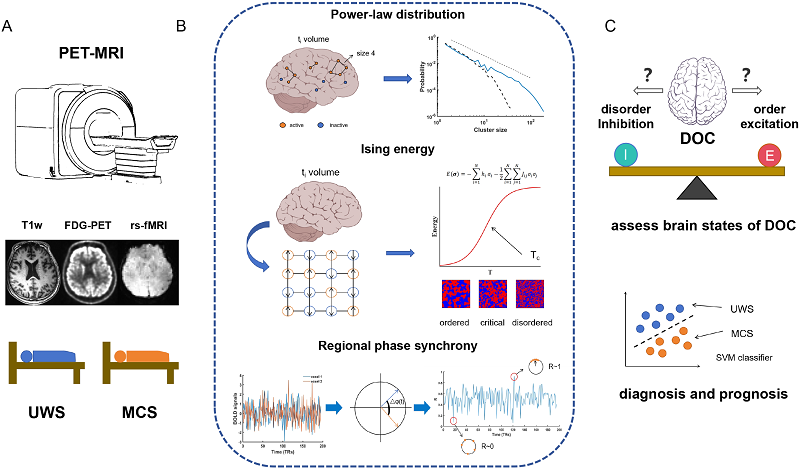
Study workflow (Image by LIU Ning’s group)
<関連情報>
- https://english.cas.cn/newsroom/research-news/202608/t20260813_1187888.shtml
- https://www.nature.com/articles/s42003-026-10713-y
脳の臨界状態は、意識障害における異常な神経ダイナミクスと代謝を特徴づける Brain criticality characterizes abnormal neural dynamics and metabolism in disorder of consciousness
Qianqian Ge,Yumeng Xin,Chen He,Shuai Han,Xiaoli Geng,Xueling Chen,Shan Yu,Jianghong He,Ning Liu & Long Xu
Communications Biology Published:20 July 2026
DOI:https://doi.org/10.1038/s42003-026-10713-y Unedited version
Abstract
Revealing how disrupted brain dynamics lead to altered consciousness levels remains a central challenge in understanding the neural mechanisms underlying consciousness. The brain criticality framework offers a promising perspective, in which optimal neural integration and information processing occur when the brain operates near a critical point, while also reflecting fundamental neural processes such as excitation/inhibition balance. Here, we combined resting-state functional magnetic resonance imaging (fMRI) and positron emission tomography (PET) to systematically assess brain criticality in disorder of consciousness (DoC) patients. Our results revealed that patients in an unresponsive wakefulness state (UWS) exhibited significantly greater power-law scaling exponents in co-activation clusters, higher Ising energy, and lower phase synchronization compared to those in a minimally conscious state (MCS). These findings suggest a greater deviation from critical brain dynamics in UWS, reflecting diminished neural integration and increased disorder. The extent of these deviations correlated with metabolic deficits measured by PET, highlighting the functional relevance of altered neural dynamics. Importantly, critical metrics were significantly associated with clinical scores and outperformed PET in both diagnosis and prognosis. Together, our findings advance understanding of the neural mechanisms underlying consciousness and highlight the potential of criticality-based metrics for characterizing brain states and informing prognosis in DoC.