2026-08-31 東北大学
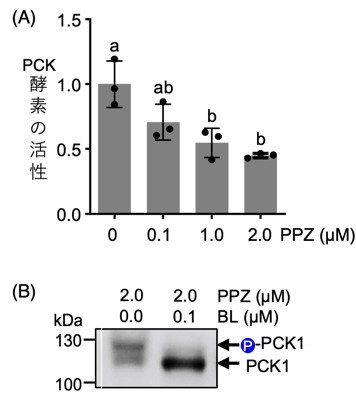
図1. ブラシノステロイドによりPCK酵素活性が変化する。(A)ブラシノステロイド生合成阻害剤 PPZを投与すると濃度依存的にPCK酵素の活性が低下する。 (B) PPZを与えるとリン酸化されたPCK1(P-PCK1)が増えるが、活性型ブラシノステロイドBLを与えると脱リン酸化される。
<関連情報>
- https://www.tohoku.ac.jp/japanese/2026/08/press20260831-01-Brassinosteroids.html
- https://www.nature.com/articles/s41477-026-02379-5
ブラシノステロイドは、ホスホエノールピルビン酸カルボキシキナーゼのBIN2リン酸化を阻害することにより糖合成を促進する Brassinosteroids promote sugar synthesis by inhibiting BIN2 phosphorylation of phosphoenolpyruvate carboxykinase
Hongliang Zhang,Yalikunjiang Aizezi,Kanako Bessho-Uehara,Ajeet Chaudhary,Cao Son Trinh,Shou-Ling Xu & Zhi-Yong Wang
Nature Plants Published:28 August 2026
DOI:https://doi.org/10.1038/s41477-026-02379-5
Abstract
Sugar is both an essential energy source and the major substrate for cell wall biosynthesis during plant growth, yet how growth-promoting hormones regulate sugar synthesis remains unclear. Here we show that the brassinosteroids (BRs) promote gluconeogenic and photosynthetic sugar synthesis by activating phosphoenolpyruvate carboxykinase (PCK), which catalyses the conversion of oxaloacetate to phosphoenolpyruvate, a central step in primary metabolism. Arabidopsis BR-deficient mutants display reduced PCK1 activity and elevated phosphorylation at conserved Ser-62 and Thr-66 residues. BR treatment induces PCK1 dephosphorylation and activation, whereas the GSK3-like kinase BIN2 phosphorylates these sites, altering quaternary structure and inhibiting PCK1. Phospho-blocking mutations of Ser-62/Thr-66 confer BR-independent PCK1 activity and enhance seedling growth, while phosphomimetic mutations reduce PCK1 activity and impair seedling growth and establishment. BRs also promote PCK dephosphorylation and activation in photosynthetic leaves of maize and sorghum. Our study demonstrates that BRs regulate primary metabolism via GSK3/BIN2-mediated phosphorylation of PCK, thereby promoting gluconeogenesis and photosynthesis.