
2026-09-09 カリフォルニア大学バークレー校(UCB)
<関連情報>
- https://news.berkeley.edu/2026/09/09/new-ai-model-for-dna-learns-from-evolution-to-unlock-secrets-of-the-human-genome/
- https://www.nature.com/articles/s41586-026-11005-5
GPN-Starを用いたゲノムワイドな機能制約の予測 Predicting genome-wide functional constraints with GPN-Star
Chengzhong Ye,Gonzalo Benegas,Carlos Albors,Jianan Canal Li,Sebastian Prillo,Peter D. Fields,Brian Clarke & Yun S. Song
Nature Published:09 September 2026
DOI:https://doi.org/10.1038/s41586-026-11005-5
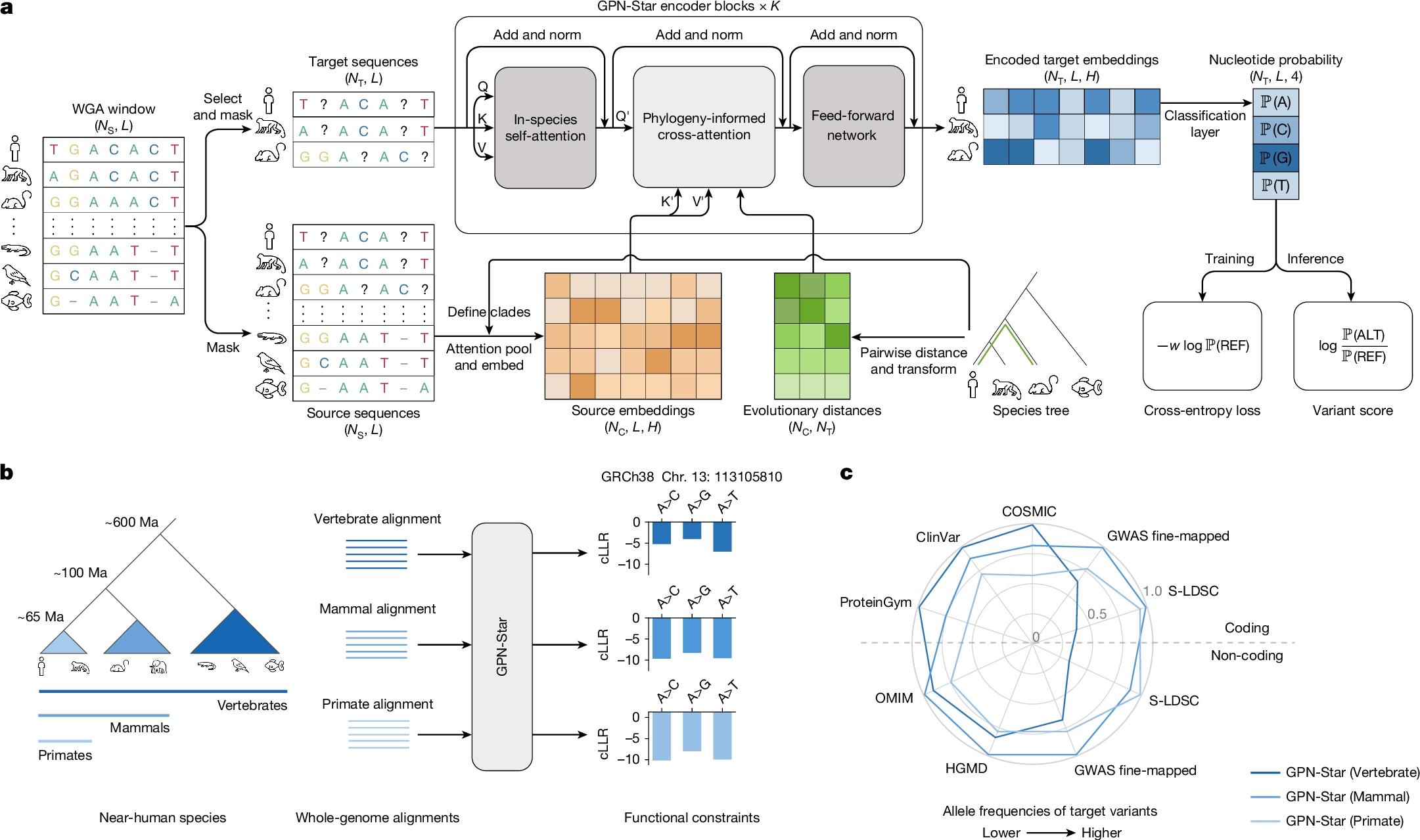
Abstract
Genomic language models have emerged as a powerful approach for learning genome-wide functional constraints directly from DNA sequences1. However, standard genomic language models adapted from natural language processing often require large model sizes and computational resources, yet still fall short of classical evolutionary models in predictive tasks2,3,4. Here we introduce a genomic pretrained network with species tree and alignment representations (GPN-Star), which is a biologically grounded genomic language model featuring a phylogeny-aware architecture that leverages whole-genome alignments and species trees to model evolutionary relationships explicitly. Trained on alignments spanning vertebrate, mammal and primate evolutionary timescales, GPN-Star achieves state-of-the-art performance across a wide range of variant effect prediction tasks in both coding and non-coding regions of the human genome. Analyses across timescales show task-dependent advantages of modelling more recent versus deeper evolution. To demonstrate its potential to advance human genetics, we show that GPN-Star substantially outperforms previous methods in prioritizing pathogenic and fine-mapped genome-wide association study variants, yields strong enrichments of complex trait heritability and improves power in rare variant association testing5. Extending beyond humans, we train GPN-Star for five model organisms—Mus musculus, Gallus gallus, Drosophila melanogaster, Caenorhabditis elegans and Arabidopsis thaliana—demonstrating the robustness and generalizability of the framework. Taken together, these results position GPN-Star as a scalable, powerful and flexible tool for genome interpretation, well suited to leverage the growing abundance of comparative genomics data.

