2026-09-14 スウェーデン王立工科大学(KTH)
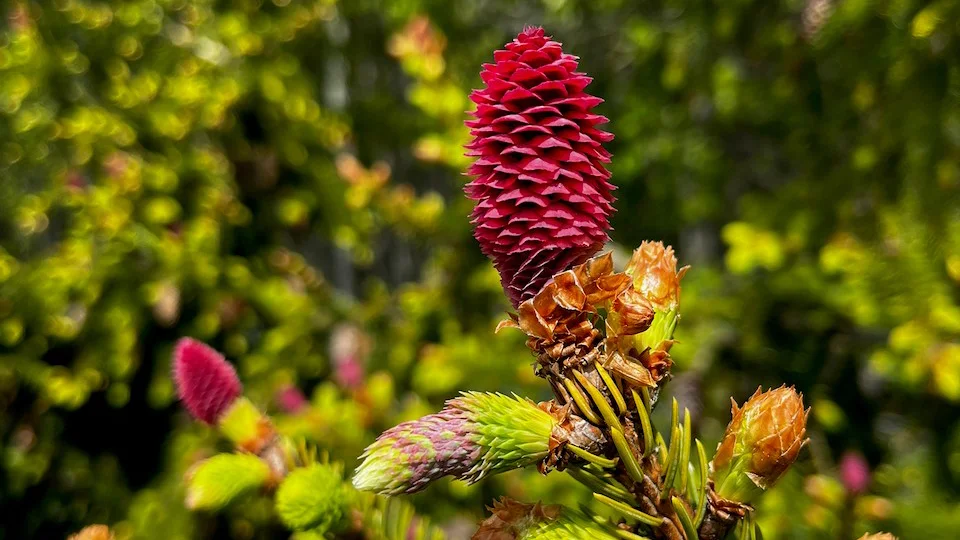
How does a young spruce shoot decide whether to become a branch or a cone? Researchers at KTH and SLU have created a detailed genetic map that begins to answer that question, offering new clues about how one of Northern Europe’s most important tree species reproduces. Photo: Jens Sundström
<関連情報>
- https://www.kth.se/en/om/nyheter/centrala-nyheter/why-do-spruce-take-decades-to-reproduce-a-genetic-study-offers-new-clues-1.1495520
- https://www.cell.com/cell/fulltext/S0092-8674(26)01006-8
ノルウェーマツの針葉樹生殖発生の時空間プログラム Norway spruce spatiotemporal programs of conifer reproductive development
Sami Saarenpää ∙ Nathan Zivi ∙ Yuvarani Masarapu ∙ … ∙ Nathaniel R. Street ∙ Jens F. Sundström ∙ Stefania Giacomello
Cell Published:September 14, 2026
DOI:https://doi.org/10.1016/j.cell.2026.08.033
Highlights
- Spatiotemporal transcriptomics identifies conifer developmental regulators
- Spatiotemporal co-expression networks explain developmental and morphological shifts
- DAL55 regulates lateral organ development in conifers
- Conserved YABBY gene family evolution links tissue patterning across seed plants
Summary
Conifers are essential components of forest ecosystems; however, their reproductive development remains largely understudied due to their genomes’ complexity. Here, we present a time-resolved spatial transcriptomics (ST) atlas of 88 tissue sections across three time points from developing reproductive and vegetative shoots in wild-type Norway spruce (Picea abies), as well as transition shoots from the acrocona mutant. By studying their different spatiotemporal gene expression dynamics, we identified molecular processes active during the vegetative-to-reproductive shift and their specific spatial domains in the shoots. We also identified and experimentally characterized the MADS-box gene DAL55, which is active during lateral organ development. Moreover, we shed light on the evolutionary relationships between gymnosperm and angiosperm YABBY genes, responsible for inner or outer cell layers in complex structures. Overall, our spatiotemporal atlas identifies genes, pathways, and evolutionary relationships associated with plant reproductive organs, providing a valuable resource for studying conifer reproductive development.