
2026-09-16 筑波大学
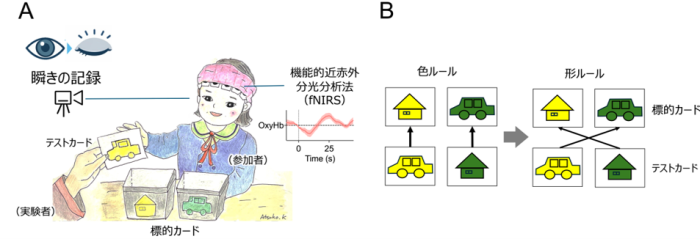
図1. 実験の様子と課題の構成。
<関連情報>
- https://www.tsukuba.ac.jp/journal/medicine-health/20260916140000.html
- https://www.tsukuba.ac.jp/journal/pdf/p20260916140000.pdf
- https://www.nature.com/articles/s44271-026-00524-6
幼児期に現れ始める瞬きの頻度は実行機能の神経起源と関連する Emergent blink rate in early childhood is associated with neural origins of executive function
Ryuta Kuwamizu,Nozomi Yamamoto,Kota Otani & Yusuke Moriguchi
Communications Psychology Published:15 September 2026
DOI:https://doi.org/10.1038/s44271-026-00524-6
Abstract
Executive function develops rapidly in early childhood and predicts later success in life, yet its neurobiological correlates during this period are not yet well characterised. In adults, executive function is supported by prefrontal–striatal circuits under neuromodulatory control, including dopamine. Here, we show that spontaneous eye-blink rate, a physiological output influenced by neuromodulatory systems, is associated with the developmental trajectory of executive function and prefrontal functional differentiation. We used fNIRS to monitor prefrontal cortex (PFC) activation in 113 children (35–80 months) during a cognitive flexibility task. Older children showed better task performance and greater right-hemisphere and dorsal bias in their PFC activation. Importantly, higher eye-blink rate was also associated with this right-dorsal PFC activation and with better task performance. The current findings demonstrate that emergent eye-blink rate is associated with the neural origins of executive function development in young children. This highlights the potential of eye-blink rate to serve as a unique and previously unrecognised indicator of this critical developmental neural mechanism.

.jpg "思春期におけるメンタルヘルスの男女差 孤独感とやせ願望が多くを説明 ― 若者との共同研究 ―")