2026-09-17 マウントサイナイ医療システム(MSHS)
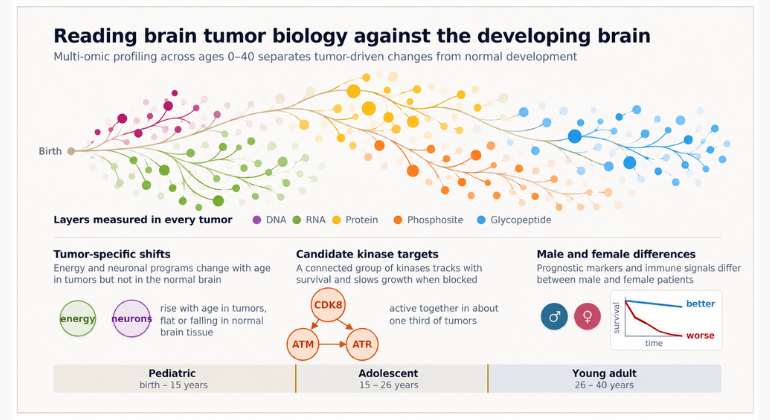
Proteogenomic profiling of high-grade glioma from infancy through age 40 shows age-related tumor changes distinct from normal brain development, candidate kinase targets, and differences between male and female patients.
<関連情報>
- https://www.mountsinai.org/about/newsroom/2026/study-identifies-candidate-treatment-targets-for-high-grade-glioma-in-children-and-young-adults
- https://www.cell.com/cell-reports-medicine/fulltext/S2666-3791(26)00441-6
小児およびAYA世代の高悪性度神経膠腫のプロテオゲノム解析により、年齢依存的な生物学的特徴、男女差、およびキナーゼ標的が明らかになった Proteogenomic analysis of pediatric and AYA high-grade glioma reveals age-dependent biology, female-male differences, and kinase targets
Nicole L. Tignor ∙ Mateusz Koptyra ∙ Shrabanti Chowdhury ∙ … ∙ Philadelphia Coalition for a Cure ∙ Children’s Brain Tumor Network ∙ Clinical Proteomic Tumor Analysis Consortium
Cell Reports Medicine Published:September 17, 2026
DOI:https://doi.org/10.1016/j.xcrm.2026.103024
Highlights
- Deep multi-omics characterization of 112 pediatric, adolescent, and young adult HGGs
- Distinct genetic, transcriptomic, and proteomic features across age and sex groups
- Druggable targets revealed by causal network analysis of kinase activities
- Proteins and immune signatures linked to poor outcomes
Summary
High-grade gliomas (HGGs) in children and adolescents and young adults (AYA) exhibit distinct biology across the neurodevelopmental spectrum. To dissect tumor-intrinsic molecular characteristics independent of developmental variation, we perform comprehensive proteogenomic analyses of tumors from 112 HGG patients aged 0–40 years. Our multi-omics analysis identifies two AYA subgroups—adolescents (aged 15–26 years) and young adults (aged 26–40 years)—with distinct molecular profiles and survival outcomes. Tumor-normal comparisons and survival modeling highlight roles of oxidative phosphorylation and neuronal system biology in glioma progression. Causal network analysis and cell line studies provide a rationale for personalized therapies targeting candidate kinases, such as CDK8. Survival modeling, clustering, and immune-landscape analyses identify proteins, post-translational modifications, and immune signatures linked to outcomes and reveal clinically relevant differences between male and female patients.