2026-10-08 カロリンスカ研究所(KI)
<関連情報>
- https://news.ki.se/hpv-vaccinated-women-had-a-lower-risk-of-preterm-birth
- https://www.bmj.com/content/395/bmj-2026-100739
妊娠前の4価ヒトパピローマウイルスワクチン接種と妊娠転帰:全国規模の集団ベース症例対照研究 Quadrivalent human papillomavirus vaccination before pregnancy and pregnancy outcomes: nationwide, population based case-control study
Zhongsong Zhang, doctoral student,Alexander Ploner, senior statistician,Verena Sengpiel, professor,Nestory Kasheshi, gynecologist,Bo Jacobsson, professor,Joakim Dillner, professor,Pär Sparén, professor emeritus,Cecilia Kärrberg, senior consultant,Jiayao Lei, assistant professor
The BMJ Published: 07 October 2026
DOI:https://doi.org/10.1136/bmj-2026-100739
Abstract
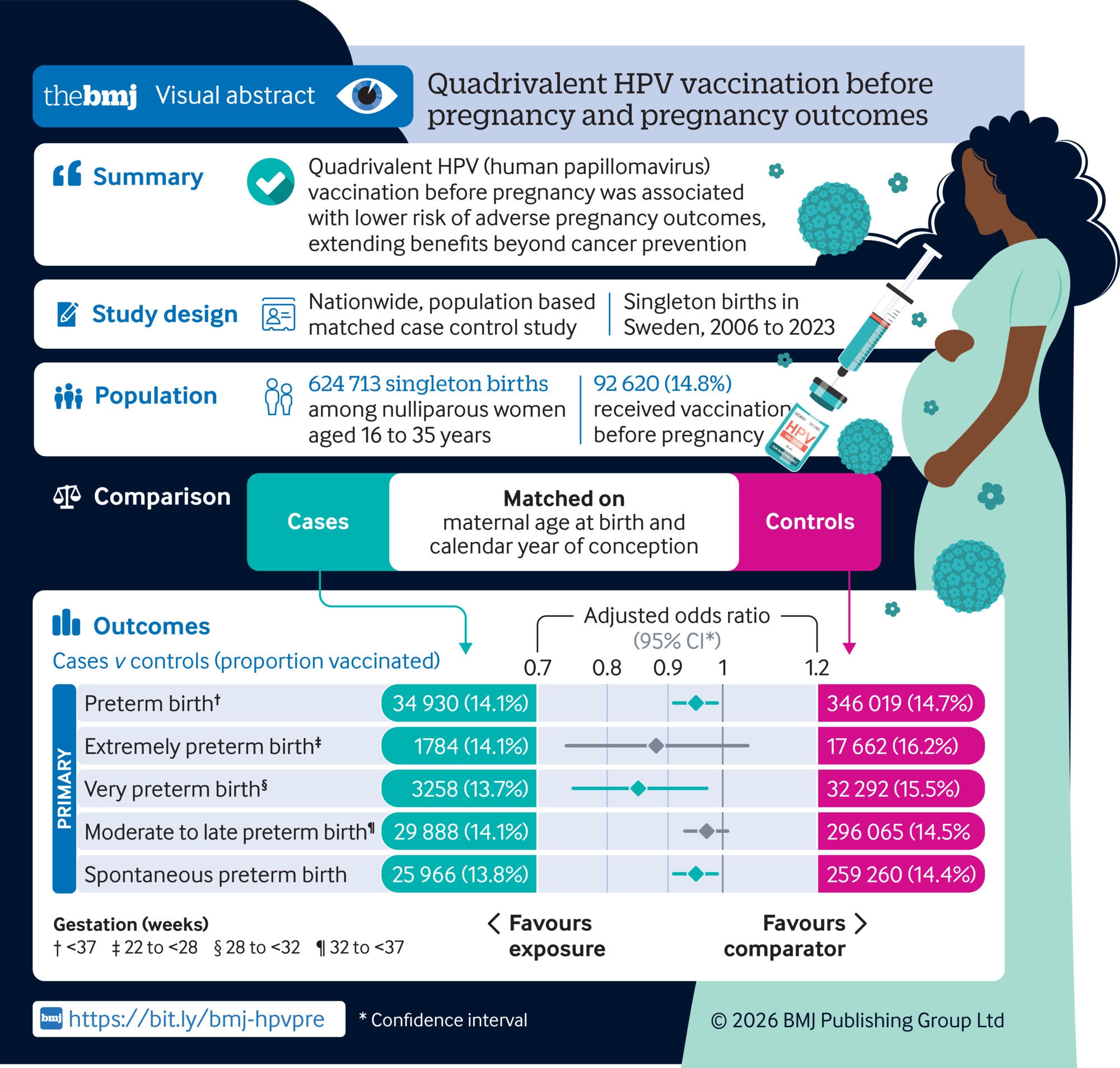
Objective To evaluate the association between quadrivalent human papillomavirus vaccination before pregnancy and subsequent risk of adverse pregnancy outcomes.
Design Nationwide, population based matched case-control study.
Setting Population of Sweden, from 1 January 2006 to 31 December 2023.
Participants 624 713 singleton births among nulliparous women aged 16-35 years in Sweden between 2006 and 2023; 92 620 (14.8%) women had received quadrivalent human papillomavirus vaccination before pregnancy.
Main outcome measures Risk of adverse pregnancy outcomes associated with quadrivalent human papillomavirus vaccination, with preterm birth (<37 weeks), including its subtypes, and spontaneous preterm birth as primary outcomes and preterm prelabour rupture of membranes, prelabour rupture of membranes, small for gestational age infant (<10th centile), severe small for gestational age infant (<3rd centile), stillbirth, and neonatal mortality as secondary outcomes. Effect modification by age at human papillomavirus vaccination was assessed. Conditional logistic regression was used to estimate odds ratios and adjusted odds ratios with 95% confidence intervals (CIs).
Results After adjustment for confounders, quadrivalent human papillomavirus vaccination was associated with lower odds of all included adverse pregnancy outcomes. Statistically significant associations were observed for preterm birth (<37 weeks) (adjusted odds ratio 0.95, 95% CI 0.91 to 0.99), very preterm birth (28 weeks to 31 weeks) (0.85, 0.75 to 0.97), spontaneous preterm birth (0.95, 0.91 to 0.99), preterm prelabour rupture of membranes (0.93, 0.87 to 1.00), and severe small for gestational age infant (0.92, 0.87 to 0.97). Risk reduction was generally more pronounced among women vaccinated at younger ages.
Conclusions Quadrivalent human papillomavirus vaccination before pregnancy was associated with a lower risk of adverse pregnancy outcomes, particularly among women vaccinated at earlier ages, extending benefits of human papillomavirus vaccination beyond cancer prevention.