
2026-10-21 愛媛大学
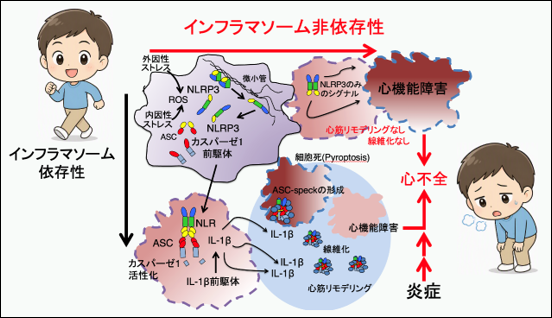
NLRP3インフラマソームが持続的に形成されると、心線維化、心拡大、心機能低下がみられました。
<関連情報>
- https://www.ehime-u.ac.jp/data_relese/pr_20261021_med/
- https://academic.oup.com/jimmunol/article/215/10/vkag257/8935205
長期的なNlrp3機能獲得型変異は、インフラマソーム非依存性の心機能障害を促進する Long-term Nlrp3 gain-of-function mutation promotes cardiac dysfunction independent of inflammasome in mice
Mie Kurata, Kayo Takahashi, Naoe Kaneko, Kenji Kameda, Takanori Nakamura, Sho Hosokawa, Kasumi Murakami, Hideki Ogura, Satoshi Ishido, Osamu Yamaguchi,…
The Journal of Immunology Published:19 October 2026
DOI:https://doi.org/10.1093/jimmun/vkag257
Abstract
Cryopyrin-associated periodic syndrome (CAPS) is an autoinflammatory disease caused by gain-of-function mutations in human nucleotide-binding domain, leucine-rich repeat–containing protein 3 (NLRP3), which lead to constitutive inflammasome activation and excessive IL-1β secretion. Long-term IL-1 blockade has markedly improved patient outcomes by preventing systemic inflammation and amyloidosis. However, whether chronic NLRP3 mutation exerts inflammasome-independent effects on the cardiac function remains unknown. We generated Nlrp3C257Y/WT knock-in mice as a novel CAPS model. Long-term survival, systemic inflammation, and cardiac function were assessed by biochemical, histological, and echocardiographic analyses. To determine inflammasome dependency, Nlrp3C257Y/WT mice were crossed with Asc−/− mice to generate double-mutant Nlrp3C257Y/WT × Asc−/− offspring. Nlrp3C257Y/WT mice exhibited early-onset cutaneous inflammation that gradually subsided, these mice developed marked left ventricular (LV) dilatation and mild systolic dysfunction after approximately 6 mo of age. Histological analysis revealed interstitial myocardial fibrosis in Nlrp3C257Y/WT mice. This result indicates that Nlrp3C257Y/WT mutation, which operates as a gain-of-function variant for inflammasome activation, impairs cardiac function largely driven by an inflammasome-dependent mechanism. In contrast, Nlrp3C257Y/WT × Asc−/− mice exhibited marked resolution of systemic inflammation; nevertheless, LV dilatation and reduced fractional shortening persisted. Long-term Nlrp3C257Y/WT mutation can lead to persistent cardiac dysfunction not only through inflammasome activation but also via inflammasome-independent mechanisms. Our findings reveal previously unrecognized inflammasome-independent mechanisms linking NLRP3 signaling to cardiac dysfunction. This study expands knowledge of the pathophysiological spectrum of CAPS and highlights inflammasome-independent NLRP3 signaling as a potential therapeutic target to prevent chronic cardiac complications in patients with CAPS and NLRP3-associated disorders.
