2025-06-17 中国科学院(CAS)
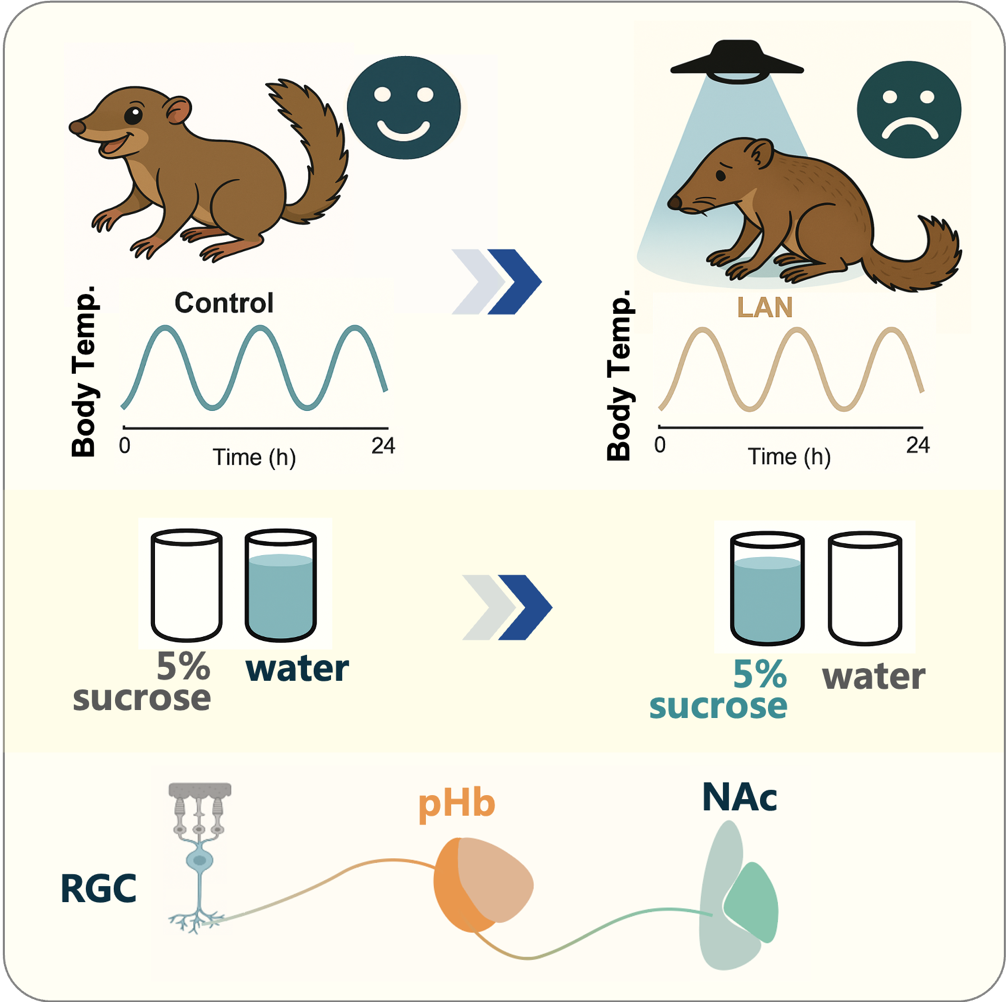 LAN exert depression-inducing effects in tree shrews via a pHb-related visual pathway. ( Image by MENG Jianjun)
<関連情報>
- https://english.cas.cn/newsroom/research_news/life/202506/t20250617_1045728.shtml
- https://www.pnas.org/doi/10.1073/pnas.2411280122
夜間の光は、昼行性の霊長類のようなツパイにおいて、傍手綱核に関連する視覚経路を介して気分に悪影響を及ぼす Light at night negatively affects mood in diurnal primate-like tree shrews via a visual pathway related to the perihabenular nucleus
Ying Miao, Huan Zhao, Yu-Fei L , +10 , and Tian Xue
Proceedings of the National Academy of Sciences Published:June 6, 2025
DOI:https://doi.org/10.1073/pnas.2411280122
Significance
Long-term light at night (LAN) exposure poses a health threat to nocturnal lab animals. Whether diurnal animals suffer the same deleterious effect imposed by LAN and how it works are still open questions. Our study shows that tree shrew, a primate-like diurnal animal, presents impaired mood and cognitive functions upon 3-wk LAN exposure. This effect is mediated by a conserved retina-perihabenular nucleus (pHb)-nucleus accumbens (NAc) pathway. Our findings constitute the basis for translational work aiming to prevent or treat mood disorders associated with excessive LAN.
Abstract
To better understand the potential health threats and underlying visual pathways of long-term light at night (LAN) exposure, we adopted a widely accepted diurnal animal model tree shrew (Tupaia belangeri chinensis), which is a close relative to primates, and evaluated the deleterious effects of long-term LAN exposure. We used an early-night LAN paradigm that was established in mice to examine behavioral and physiological consequences in adult male tree shrews. We found that 3-wk LAN exposure significantly impaired the mood and long-term memory of tree shrews without affecting the general activity pattern. We identified retinal projections to the perihabenular nucleus (pHb), a crucial area in LAN-induced negative mood, and demonstrated that the pHb continues to innervate the nucleus accumbens (NAc) in tree shrews. Moreover, the pHb was required for the LAN effect on mood but not long-term memory. Transcriptomic profiling of brain tissues containing the NAc area revealed drastic changes of several depression-related genes in NAc neurons post-LAN treatment, suggesting that long-term exposure to nighttime light could result in lasting changes in tree shrews. Collectively, we present behavioral and neural structural evidence that LAN exerts depression-inducing effects in diurnal animals via a pHb-related visual pathway, which may facilitate the translation from laboratory findings of excessive LAN exposure to clinical applications in humans.