2025-08-19 名古屋工業大学,科学技術振興機構
<関連情報>
- https://www.nitech.ac.jp/news/press/2025/13083.html
- https://pubs.acs.org/doi/10.1021/acs.chemrev.5c00177
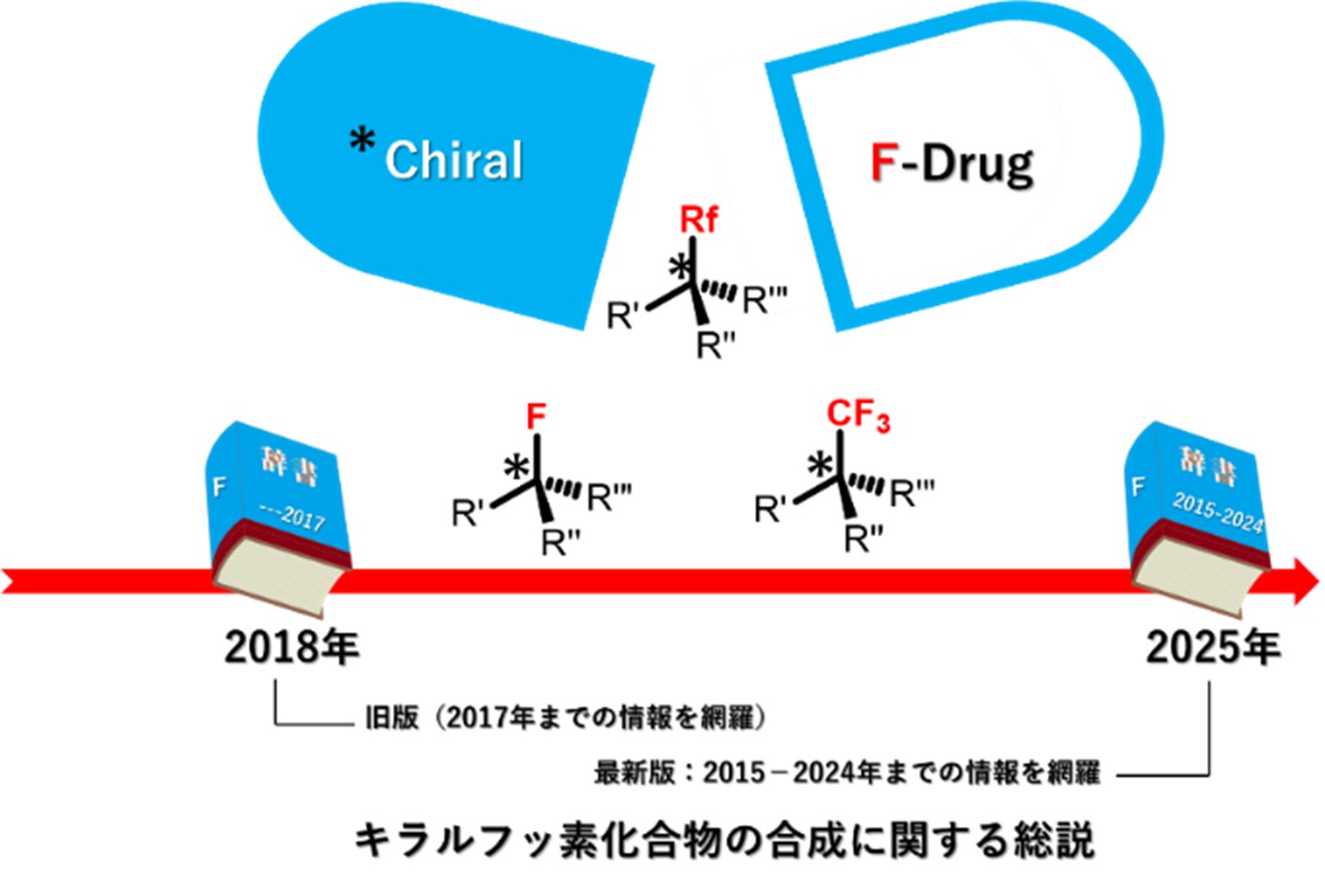
フッ素含有ステレオジェニック炭素中心を有する分子の触媒的不斉合成に関する最近の進展(2015–2024) Recent Advances on Catalytic Asymmetric Synthesis of Molecules Bearing a Fluorine-Containing Stereogenic Carbon Center (2015–2024)
Subarna Jyoti Kalita,Jing Qi,Lu Xiao,Debarshi Saha,Yi-Yong Huang,and Norio Shibata
Chemical Reviews Published: August 6, 2025
DOI:https://doi.org/10.1021/acs.chemrev.5c00177
Abstract
Fluorine, due to its unique ability to modify the physicochemical and biological properties of parent molecules, has found wide applications as pharmacological modulators in drug development research. Consequently, the portion of fluorine-containing drugs has increased to about 20% in recent years. Among these, fluorine-containing drugs with aromatic fluoro-substitutions are more common than those with fluoro-substitutions at stereogenic centers. In fact, in the past decade, out of 116 fluorine-containing drugs approved by the FDA only 16 drugs are enantiomerically pure, featuring fluorine-containing stereogenic carbon centers. Asymmetric induction during building these drug molecules is largely achieved through either the “chiral pool” or “chiral resolution” approach, while the “asymmetric catalysis” approach remains underexplored. In order to draw the attention of the scientific community to this disparity, this review highlights the innovations (2015–2024) in asymmetric methodologies for creating molecules bearing a fluorine-containing stereogenic carbon center in the presence of organo- or organometallic catalysts. The synthetic strategies are divided into two sections based on fluorine-containing building blocks and fluorine-containing reagents, which are further classified by the reaction types. Special attention has been paid to synthetic challenges, types of substrates, products and catalysts, functional group compatibility, transition states, mechanistic insights, as well as synthetic applications.