2025-08-25 シカゴ大学 (UChicago)
<関連情報>
- https://news.uchicago.edu/story/scientists-program-cells-create-biological-qubit-quantum-breakthrough
- https://www.nature.com/articles/s41586-025-09417-w
蛍光タンパク質スピン量子ビット A fluorescent-protein spin qubit
Jacob S. Feder,Benjamin S. Soloway,Shreya Verma,Zhi Z. Geng,Shihao Wang,Bethel B. Kifle,Emmeline G. Riendeau,Yeghishe Tsaturyan,Leah R. Weiss,Mouzhe Xie,Jun Huang,Aaron Esser-Kahn,Laura Gagliardi,David D. Awschalom & Peter C. Maurer
Nature Published:20 August 2025
DOI:https://doi.org/10.1038/s41586-025-09417-w
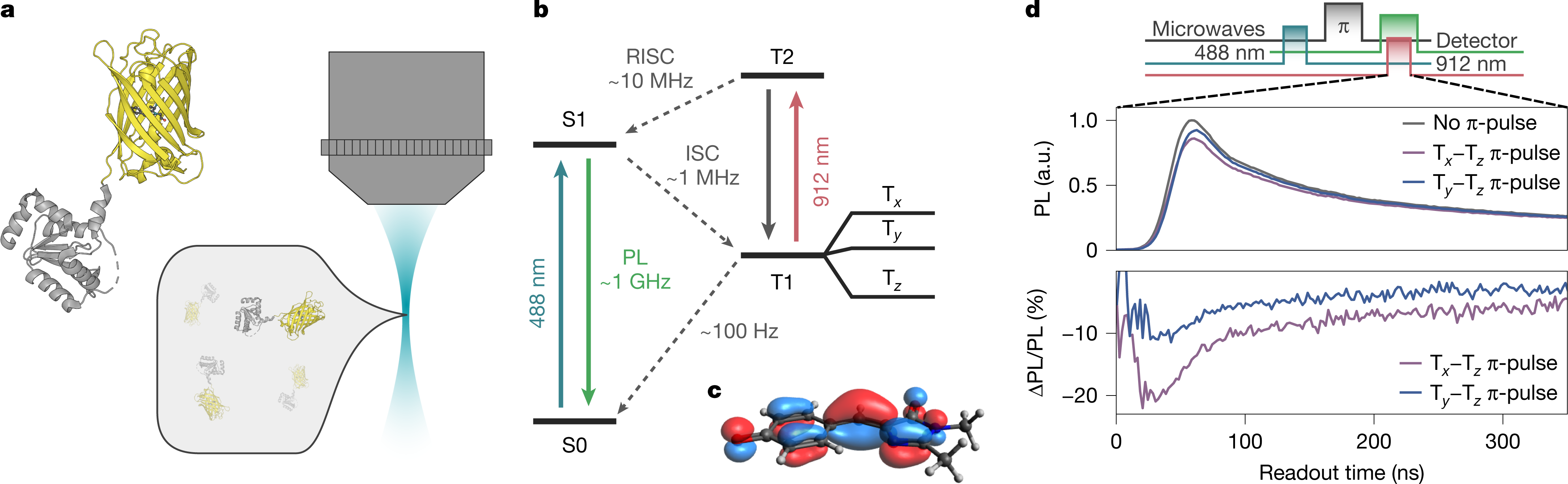
Abstract
Quantum bits (qubits) are two-level quantum systems that support initialization, readout and coherent control1. Optically addressable spin qubits form the foundation of an emerging generation of nanoscale sensors2,3,4,5,6,7. The engineering of these qubits has mainly focused on solid-state systems. However, fluorescent proteins, rather than exogenous fluorescent probes, have become the gold standard for in vivo microscopy because of their genetic encodability8,9. Although fluorescent proteins possess a metastable triplet state10, they have not been investigated as qubits. Here we realize an optically addressable spin qubit in enhanced yellow fluorescent protein. A near-infrared laser pulse enables triggered readout of the triplet state with up to 20% spin contrast. Using coherent microwave control of the enhanced-yellow-fluorescent-protein spin at liquid-nitrogen temperatures, we measure a (16 ± 2) μs coherence time under Carr–Purcell–Meiboom–Gill decoupling. We express the qubit in mammalian cells, maintaining contrast and coherent control despite the complex intracellular environment. Finally, we demonstrate optically detected magnetic resonance in bacterial cells at room temperature with contrast up to 8%. Our results introduce fluorescent proteins as a powerful qubit platform that paves the way for applications in the life sciences, such as nanoscale field sensing and spin-based imaging modalities.