2025-10-17 産業技術総合研究所
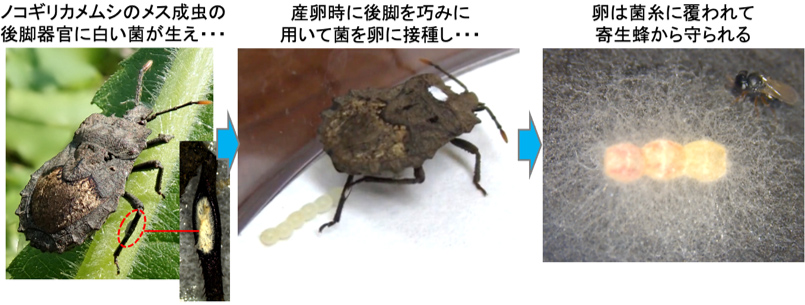
ノコギリカメムシのメス成虫は後脚の共生器官で特定の糸状菌を培養して、産卵時に卵表面に接種する卵塊が菌糸で覆われることで、寄生蜂のアクセスを物理的に阻害して卵を守る
<関連情報>
- https://www.aist.go.jp/aist_j/press_release/pr2025/pr20251017/pr20251017.html
- https://www.science.org/doi/10.1126/science.adp6699
昆虫の後ろ脚における防御的な真菌共生 Defensive fungal symbiosis on insect hindlegs
Takanori Nishino, Minoru Moriyama, Hiromi Mukai, Masahiko Tanahashi, […] , and Takema Fukatsu
Science Published:16 Oct 2025
DOI:https://www.science.org/doi/10.1126/science.adp6699
Editor’s summary
Many invertebrates are preyed on by parasitoid wasps that lay their eggs in or on another organism’s body for their hatchling larvae to feed upon. Nishino et al. discovered that females of a small dinidorid stinkbug have evolved a mechanism to help their offspring avoid this fate. The wasps have symbiotic organs on their hindlegs with a tympanum-like structure. The outer cuticle has pores through which the authors observed fungal hyphae emerging. Several fungal species are selected by the females, which notably include cordyceps that are often insect pathogens. When the female bugs lay their eggs, they rub the cultivated hyphae across the egg mass. The hyphae grow to envelope the eggs and physically exclude attentive parasitoid wasps until the bugs hatch. —Caroline Ash
Abstract
Dinidorid stinkbugs were reported to possess a conspicuous tympanal organ on female hindlegs. In this study, we show that this organ is specialized to retain microbial symbionts rather than to perceive sound. The organ’s surface is not membranous but consists of porous cuticle in which each pore connects to glandular secretory cells. In reproductive females, the hindleg organ is covered with fungal hyphae that grow from the pores. Upon oviposition, the females transfer the fungi from the organ to the eggs, where the hyphae physically protect the eggs against wasp parasitism. The fungi comprise a diversity of mostly low-pathogenicity Cordycipitaceae.