
2025-12-03 横浜市立大学
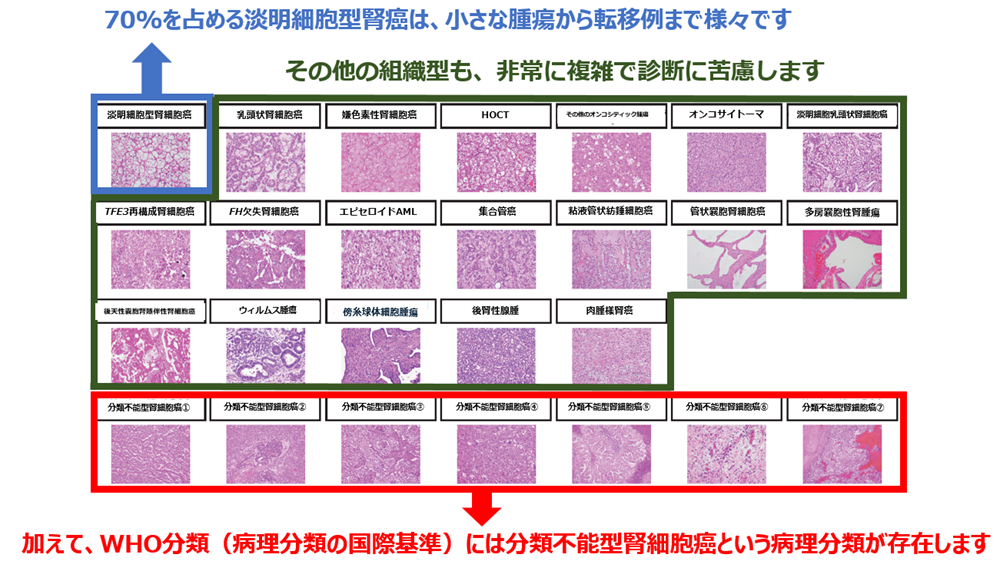
図1 腎癌の多様性
<関連情報>
- https://www.yokohama-cu.ac.jp/res-portal/news/20251203hasumi.html
- https://www.yokohama-cu.ac.jp/res-portal/news/gjok7g0000002p8m-att/20251203hasumi.pdf
- https://www.nature.com/articles/s41467-025-65303-z
希少腎癌の複雑な分類を補助する比較トランスクリプトームアトラス Comparative transcriptome atlas as an assistive modality for complex classification of rare kidney cancers
Ryosuke Jikuya,Todd A. Johnson,Erika Muraoka,Go Noguchi,Shigekatsu Maekawa,Wataru Obara,Kazuyuki Numakura,Tomonori Habuchi,Kazuhiro Maejima,Shota Sasagawa,Yuki Kanazashi,Hwajin Lee,Woo Jeung Song,Hajime Sasagawa,Taku Mitome,Shinji Ohtake,Sachi Kawaura,Yasuhiro Iribe,Kota Aomori,Hirotaka Nagasaka,Tomoyuki Tatenuma,Daiki Ueno,Mitsuru Komeya,Hiroki Ito,… Hisashi Hasumi
Nature Communications Published:24 November 2025
DOI:https://doi.org/10.1038/s41467-025-65303-z
Abstract
There is a great unmet medical need for development of molecularly characterizing modalities to assist in the complex classification of rare kidney cancers, some of which are diagnosed as unclassified renal cell carcinoma (unclassified RCC) due to complex histology. Here we show utility of the comparative transcriptome atlas as an assistive modality for complex classification of rare kidney cancers. Whereas whole genome sequencing (WGS) of 52 rare kidney cancers identifies very few clinically significant variants in a subset of cases, unsupervised clustering results of RNA-seq data from 219 renal tumors including 140 rare kidney cancers are largely consistent with the histological classification based on WHO2022 classification. Additionally, the comparative transcriptome atlas may provide an opportunity to define the molecular characteristics of unclassified RCC and might predict patient outcome. These findings support the comparative transcriptome atlas as an assistive modality for complex classification of rare kidney cancers.
