2026-02-19 ワシントン州立大学(WSU)
<関連情報>
- https://news.wsu.edu/press-release/2026/02/19/prenatal-infection-increases-risk-of-heavy-drinking-later-in-life/
- https://link.springer.com/article/10.1007/s00213-025-06998-2
出生前抗酸化治療は、性別特異的な方法で母親の免疫活性化によって引き起こされるアルコール自己投与の増加を抑制する Prenatal antioxidant treatment suppresses maternal immune activation induced increases in alcohol self-administration in a sex-specific manner
Skylar E. Nicholson,Kelly A. Hewitt,Cara S. Brauen & Angela M. Henricks
Psychopharmacology Published:02 January 2026
DOI:https://doi.org/10.1007/s00213-025-06998-2
Abstract
Rationale
Prenatal exposure to infection is a risk factor for neuropsychiatric disorders that often co-occur with alcohol misuse. However, the mechanisms by which early exposure to infection might increase the risk of such disorders remains unclear. One hypothesis is that prenatal stressors interact with adolescent stressors (i.e., “two-hits”) to promote alcohol misuse development.
Objectives
The current project tested whether maternal immune activation (MIA) combined with adolescent alcohol exposure (AA) increases the motivation to work for alcohol and negative affect in adulthood, and whether prenatal antioxidant treatment prevents these effects.
Methods
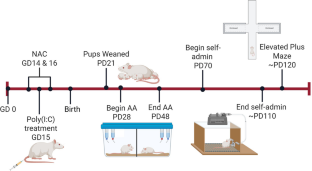
Pregnant Sprague-Dawley rats were exposed to poly(I: C) (4 mg/kg) or saline on gestational day 15, and the antioxidant n-acetylcysteine (NAC; 100 mg/kg) or saline 24 h before and after poly(I: C). Offspring had 24-hour access to 10% ethanol and water during adolescence. In adulthood, offspring were trained to self-administer 10% ethanol and tested on escalating schedules of reinforcement. Elevated plus maze (EPM) behavior was assessed on non-self-administration days.
Results
Poly(I: C) and NAC treatment independently led to an increased willingness to work for alcohol in males, but not females, relative to same-sex controls. NAC treatment suppressed the MIA-induced increase in alcohol-seeking. Poly(I: C) increased locomotor activity in the EPM in both sexes, independent of NAC, without altering open or closed arm time.
Conclusions
These data support the hypothesis that MIA-induced oxidative stress negatively influences development, leaving the brain more susceptible to the negative effects of AA, and increasing the risk of alcohol misuse in adulthood, particularly in males.