2026-02-27 ペンシルベニア州立大学(Penn State)
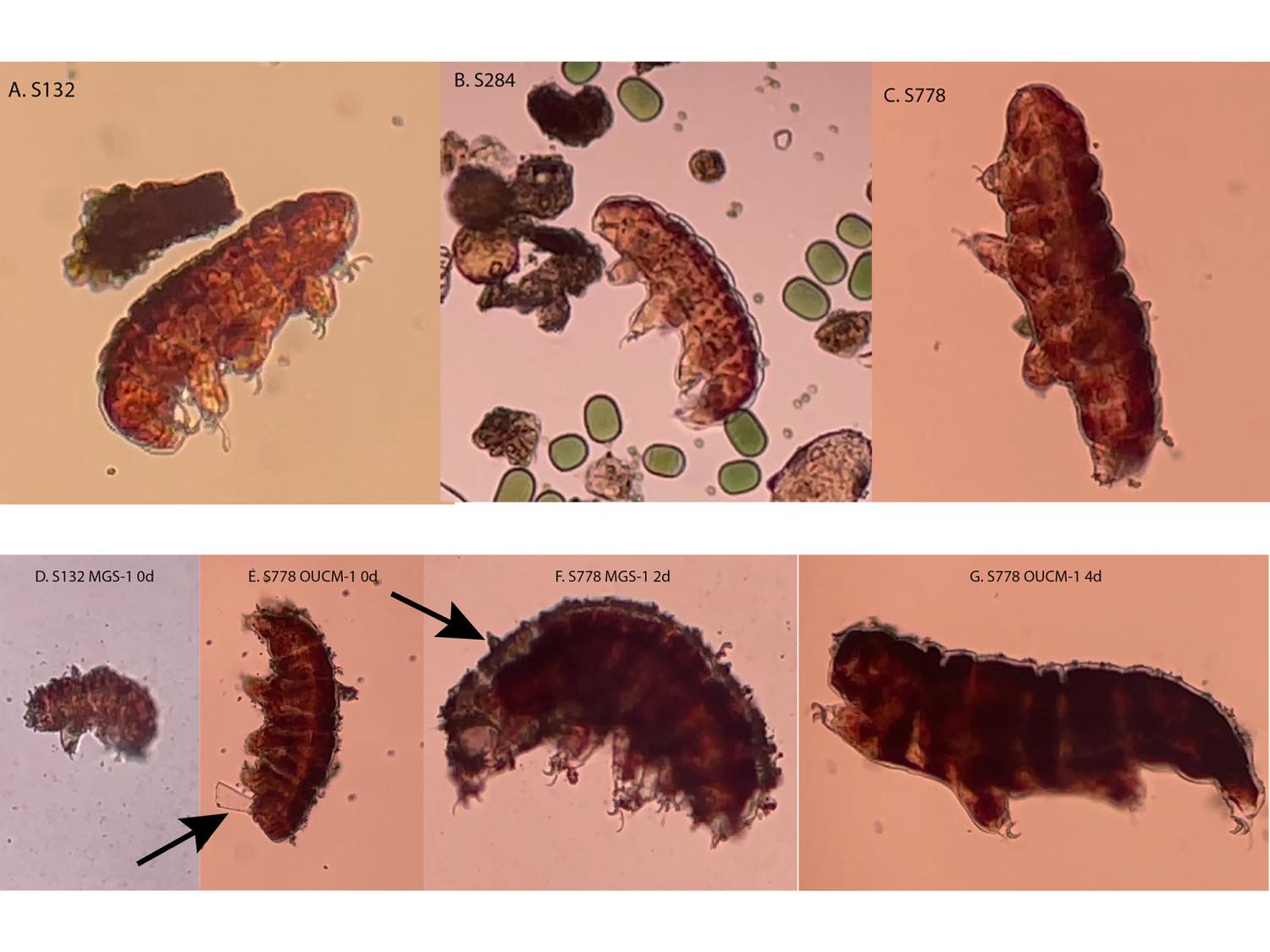 Tardigrades, a type of microscopic animal, in can reveal information about how life interacts with simulated Martian mineral deposits. The three images on top are active tardigrades in a typical Earth environment of beach sand. The bottom four images active tardigrades after some time in the simulated Martian soils, with arrows noting some mineral interactions. Credit: Provided by Corien Bakermans/Penn State. All Rights Reserved.
<関連情報>
- https://www.psu.edu/news/research/story/water-bears-reveal-potential-adapting-protecting-martian-resources
- https://www.cambridge.org/core/journals/international-journal-of-astrobiology/article/shortterm-survival-of-tardigrades-ramazzottius-cf-varieornatus-and-hypsibius-exemplaris-in-martian-regolith-simulants-mgs1-and-oucm1/8A91986096FB533FB264DD056F549DF2
火星レゴリス模擬体(MGS-1およびOUCM-1)におけるクマムシ( Ramazzottius cf. varieornatusおよびHypsibius exemplaris )の短期生存 Short-term survival of tardigrades (Ramazzottius cf. varieornatus and Hypsibius exemplaris) in martian regolith simulants (MGS-1 and OUCM-1)
Corien Bakermans,Matteo Vecchi and Gillian Pearce
International Journal of Astrobiology Published:05 December 2025
DOI:https://doi.org/10.1017/S1473550425100220
Abstract
With future intended human missions to Mars, it is crucial to understand the potential habitability of martian regolith both to support plant growth and to mitigate accidental release of organisms from habitats. We tested tardigrades, a group of valuable model organisms for animal development and survival of extreme conditions, as potential candidates for establishing functional soils on Mars. Tardigrades, in their dormant cryptobiosis state, are resistant to many conditions (radiation, desiccation, etc.) and, in their active state, are important primary consumers and predators within ecosystems. We examined the active states of two taxa (Ramazzottius cf. varieornatus and Hypsibius exemplaris) of tardigrades during short-term exposure to martian regolith simulants (MGS-1 and OUCM-1) representative of Mars. Numbers of active tardigrades in martian simulants showed marked declines over four days, while numbers in controls did not. A generalized linear regression model showed that time, simulant and species were significant predictors of active tardigrades. Martian simulants MGS-1 and OUCM-1 were both inhibitory to tardigrades, however OUCM-1 was less damaging with one population of tardigrades only minimally impacted. Furthermore, washing MGS-1 significantly reduced negative impacts. These data suggest that the specific chemical nature of the simulants is damaging (not pH or solute concentration). These experiments have ramifications for the choice of species for functional soils to support plants and humans on Mars and for the limitations of terrestrial life; however, more testing is necessary to fully understand the potential habitability and dangers of martian regolith.