2026-05-01 北海道大学,長崎大学
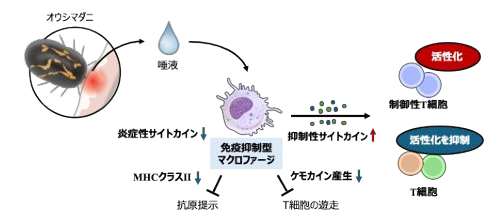
図1. オウシマダニ唾液によるマクロファージを介した免疫抑制機構
<関連情報>
- https://www.hokudai.ac.jp/news/2026/05/t-6.html
- https://www.hokudai.ac.jp/news/pdf/260501_pr.pdf
- https://www.nature.com/articles/s42003-026-09981-5
オウシマダニ唾液がマクロファージを免疫抑制の中枢へと再プログラムしてT細胞免疫を制御する Tick saliva reprograms macrophages into immunosuppressive hubs that regulate T-cell immunity in Rhipicephalus microplus infestation
Hayato Nakamura,Tomohiro Okagawa,Naoya Maekawa,Luís Fernando Parizi,Mari Ikehata,Wisa Tiyamanee,Shwe Yee Win,Hiroto Takeuchi,Keisuke Maezono,Passawat Thammahakin,Shintaro Kobayashi,Mizuki Fukuta,Minato Hirano,Kentaro Yoshii,Shiro Murata,Kazuhiko Ohashi,Carlos Logullo,Itabajara da Silva Vaz Jr & Satoru Konnai
Communications Biology Published:30 April 2026
DOI:https://doi.org/10.1038/s42003-026-09981-5
Abstract
Ticks transmit diverse pathogens and secrete saliva with immunomodulatory properties that facilitates blood feeding. However, the cellular mechanisms underlying saliva-mediated immune suppression remain poorly defined. Here, we identify macrophages as the central hub through which saliva from the cattle tick Rhipicephalus microplus suppresses T-cell mediated immunity. Tick saliva inhibited IFN-γ and TNF production by CD4⁺ and CD8⁺ T cells while enhancing IL-10 and TGF-β expression, particularly in regulatory T cells. These effects were lost upon removal of CD14⁺ cells, underscoring the importance of macrophage-lineage cells in saliva-induced immunosuppression. Transcriptomic and functional analyses showed that tick saliva reprograms macrophages into an immunosuppressive state with reduced MHC class II, attenuated proinflammatory signaling, and suppressed chemokine production. Consistent with these findings, immunofluorescence analysis of tick-feeding sites showed an increased presence of IL-10–expressing macrophages and T cells. Our findings highlight a strategy by which arthropod saliva suppresses host immunity to facilitate pathogen transmission.