2026-05-01 国立循環器病研究センター
<関連情報>
- https://www.ncvc.go.jp/pr/release/pr_52167/
- https://www.thelancet.com/journals/lanwpc/article/PIIS2666-6065(26)00067-2/fulltext
RNF213関連血管障害のもやもや病前段階における虚血性脳卒中または一過性脳虚血発作の長期転帰:NCVCゲノムレジストリからの知見 Long-term outcomes in the pre-moyamoya stage of RNF213-related vasculopathy presenting with ischaemic stroke or transient ischaemic attack: insights from the NCVC Genome Registry
Takeshi Yoshimoto ∙ Yorito Hattori ∙ Hiroyuki Ishiyama ∙ Eri Kiyoshige ∙ Soshiro Ogata ∙ Kunihiro Nishimura ∙ et al.
Lancet Regional Health—Western Pacific Published:April 25, 2026
DOI:https://doi.org/10.1016/j.lanwpc.2026.101863
Summary
Background
RNF213 is a susceptibility gene for moyamoya disease, with the p.R4810K variant being the founder mutation. However, long-term outcomes in non-moyamoya stage of RNF213-related vasculopathy remain poorly characterised in longitudinal studies.
Methods
This multicentre, prospective, longitudinal study was conducted from March 2017 to March 2022. It included patients with ischaemic stroke (IS) or transient ischaemic attack (TIA) within one week of onset. Patients with moyamoya disease were excluded. The primary outcome was recurrent symptomatic IS or TIA. Subgroup analyses with Essen Stroke Risk Score (ESRS) assessed whether the variant improved risk stratification beyond traditional factors. A retrospective validation cohort was used for sensitivity analysis.
Findings
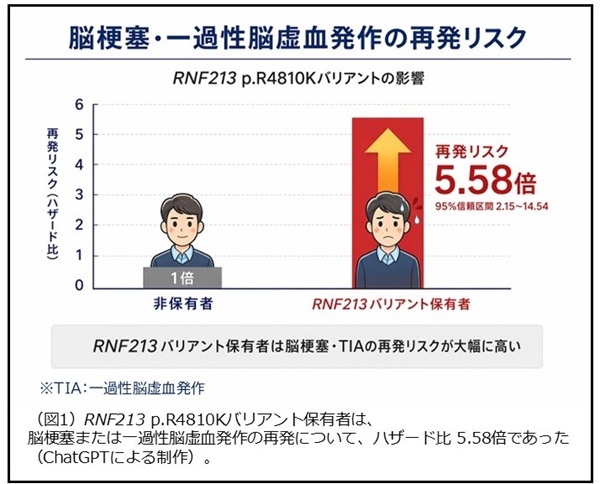
A total of 1267 patients were prospectively enrolled from eight comprehensive stroke centres across Japan. Among these patients (469 [37.0%] women; median age 75 years), 36 (2.8%) carried the variant. The median follow-up period was 3.61 years. The variant was an independent predictor of the primary outcome (adjusted hazard ratio [aHR] 5.58, 95% confidence interval [CI] 2.15–14.54). Even variant carriers with low ESRS had a higher risk of the primary outcome (aHR 4.26, 95% CI 1.32–13.71) than non-carriers with high ESRS. Among patients with largr-artery atherosclerosis, the variant remained significantly associated with the primary outcome (aHR 4.90, 95% CI 1.32–18.25). Among the variant carriers, 2.8% were newly diagnosed with moyamoya disease. In the validation cohort of the National Cerebral and Cardiovascular Center (n = 716), the variant remained an independent predictor of the primary outcome (aHR 4.47, 95% CI 2.33–8.58).
Interpretation
The RNF213 p.R4810K variant increases the risk of recurrent ischaemic events and identifies a distinct patient group with IS or TIA at “pre-moyamoya” stage.
Funding
The Japan Agency for Medical Research and Development (JP21ek0210120 and JP21ek0210126).