2026-03-04 東京科学大学
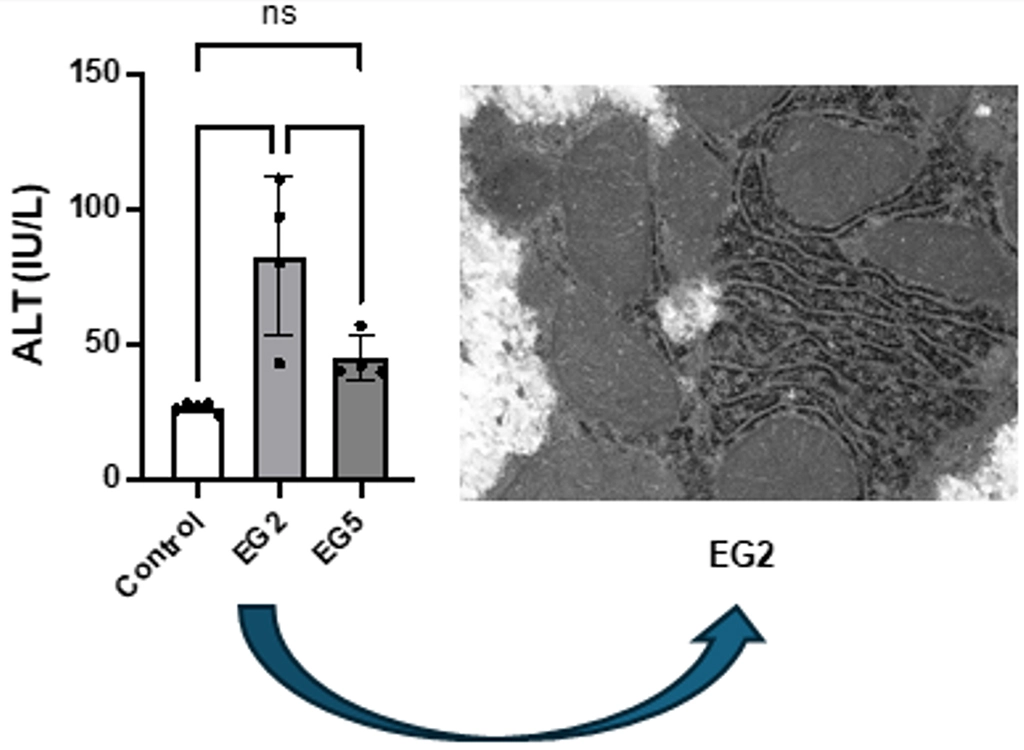
図1. 肝障害を示す酵素(ALT)はエチレングリコール(EG)投与2日後に上昇し、5日後には回復した(左)。 肝細胞にはリボゾームを伴う粗面小胞体の増加を認める(右)。
<関連情報>
- https://www.isct.ac.jp/ja/news/5odsrvfwv5gm
- https://link.springer.com/article/10.1007/s11419-026-00757-4
ラットにおけるエチレングリコールによる一過性肝障害の回復におけるリボソーム生合成の可能性のある役割 Possible role of ribosome biogenesis in the recovery from transient hepatic damage caused by ethylene glycol in rats
Kana Unuma,Toshihiko Aki,Nana Kobayashi,Shintaro Isa & Akihiro Tojo
Forensic Toxicology Published:03 February 2026
DOI:https://doi.org/10.1007/s11419-026-00757-4
Abstract
Purpose
Ethylene glycol (EG), a widely used industrial compound, has been implicated in accidental poisoning and homicide. Although the nephrotoxic mechanisms of EG are well characterized, its acute hepatotoxic potential remains underexplored. This study investigated histopathological and molecular alterations in the liver of rats following acute administration of EG. Possible dysfunction of an anti-oxidative pathway involving ferroptosis (glutathione peroxidase 4, Gpx4; solute carrier family 7 member 11, SLC7A11) is also examined.
Methods
Male rats (8-week-old, male) were orally administered EG (8 g/kg) and euthanized at 2 and 5 days post-exposure by an administration of an overdose of anesthetic (40 mg/kg sodium pentobarbital). Serological analysis was performed to assess liver function. Liver tissues were evaluated by histology, transmission electron microscopy, and transcriptome analysis.
Results
Serological findings indicated transient liver damage at 2 days post-exposure, followed by recovery at 5 days. Transmission electron microscopy revealed glycogen accumulation, corroborated by periodic acid–Schiff and periodic acid-methenamine silver staining. Histological analysis revealed an increased number of nucleoli, correlating with upregulation of ribosomal genes on microarray analysis, particularly at 5 days post-exposure. In addition, significant decreases in Gpx4 and SLC7A11 expression were observed in rat livers treated with EG and Huh-7 human hepatoma cells, suggesting reduced cellular antioxidative capacity as a contributing factor to transient liver damage.
Conclusions
These findings reveal a pathway underlying EG-induced transient liver damage and suggest a possible mechanism of recovery, thereby providing new insights into EG poisoning.