2026-03-11 中国科学院(CAS)
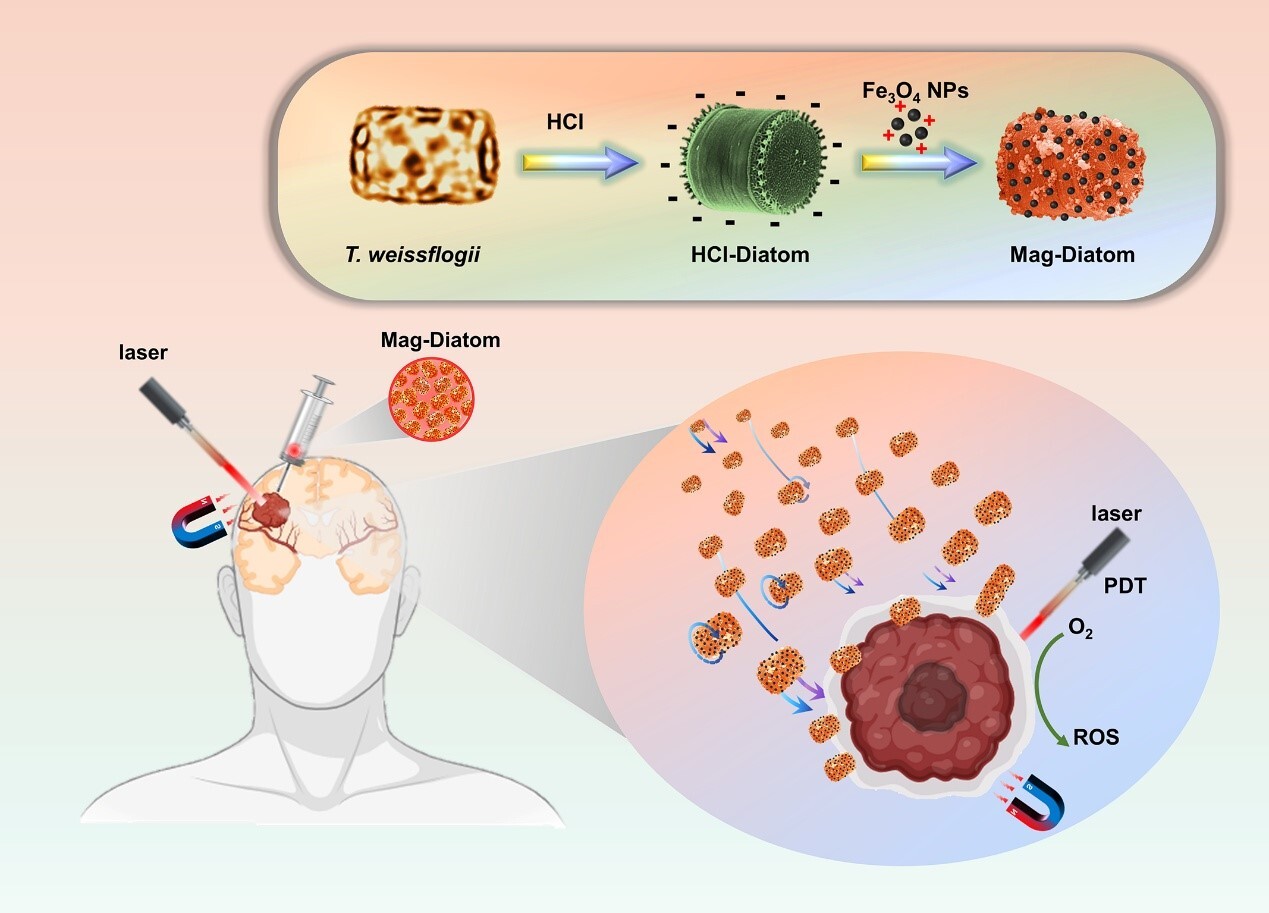
Schematic illustration of Mag-Diatom-mediated PDT (Image by SIA)
<関連情報>
- https://english.cas.cn/newsroom/research-news/202603/t20260303_1151401.shtml
- https://link.springer.com/article/10.1631/bdm.2500276
膠芽腫の光線力学療法のための珪藻類由来磁性バイオハイブリッドマイクロロボット Diatom-derived magnetic biohybrid microrobots for photodynamic therapy in glioblastoma
Mengyue Li (李梦月),Wen Cheng (程文),Xuechun Wang (汪雪纯),Junjian Zhou (周君健),Yuting Zhou (周宇婷),Tianyang Ma (马天阳),Anhua Wu (吴安华),Lianqing Liu (刘连庆) & Niandong Jiao (焦念东)
Bio-Design and Manufacturing Published:16 February 2026
DOI:https://doi.org/10.1631/bdm.2500276
Abstract
Diatoms, as natural sources of porous silica, have important potential for biomedical applications. Biohybrid microrobots also show promise for targeted delivery; however, research on converting diatoms into biohybrid microrobots and exploiting their intrinsic properties for cancer treatment remains limited. In this study, Thalassiosira weissflogii was transformed into biohybrid microrobots (Mag-Diatoms) while retaining its natural chlorophyll, thereby enabling Mag-Diatom-mediated photodynamic therapy (PDT) without additional drug modification. In this system, Mag-Diatoms acted as microrobots, and their intrinsic chlorophyll served as a photosensitizer, exhibiting excellent biological safety. The autonomous closed-loop motion of the Mag-Diatoms was achieved using an artificial intelligence algorithm, which enabled controlled navigation along a preset trajectory. Mag-Diatoms also exhibited the ability to traverse narrow slits and target cancer cells within a cellular environment. The PDT effect was validated in vitro using human malignant glioblastoma (GBM) cell lines and primary cells derived from patients. The results revealed that the cell viability was closely related to the Mag-Diatom concentration, laser intensity, and irradiation time. Under combined Mag-Diatoms and laser treatment, viability decreased to 19.5% in primary cells and 3.6% in cell line models. Moreover, in vivo experiments using a mouse glioma model revealed that Mag-Diatom-mediated PDT effectively suppressed GBM progression. These findings highlight the potential of diatom-derived biohybrid microrobots, leveraging their natural properties, as a novel material and solution for PDT-based GBM therapy.