2026-04-28 シンガポール国立大学(NUS)
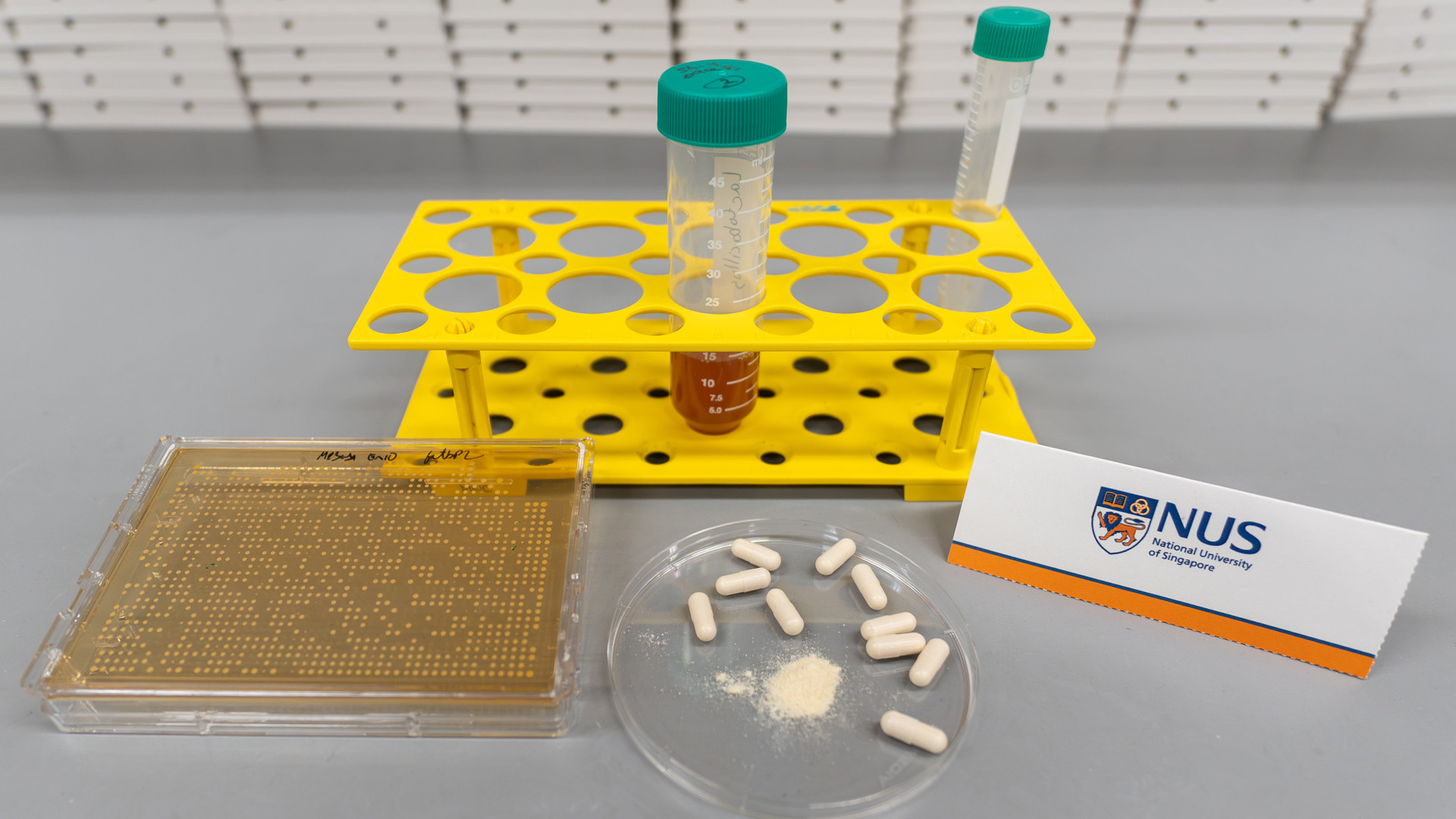
Engineered Lactobacillus plantarum shown as a liquid culture (in tube on rack), colonies on an agar plate (extreme left), and in lyophilised powder and capsule forms.
<関連情報>
- https://news.nus.edu.sg/nus-scientists-engineer-bacteria-to-treat-severe-liver-related-brain-dysfunction/
- https://www.cell.com/cell/fulltext/S0092-8674(26)00384-3
腸肝脳軸の代謝調節を目的とした遺伝子操作された共生微生物 Engineered commensals for metabolic modulation of the gut-liver-brain axis
Nikhil Aggarwal ∙ Haosheng Shen ∙ Li Ting Lee ∙ … ∙ Yung Seng Lee ∙ Yock Young Dan ∙ Matthew Wook Chang
Cell Published:April 24, 2026
DOI:https://doi.org/10.1016/j.cell.2026.03.048
Highlights
- Engineered Lactobacillus plantarum rebalances metabolites in hepatic encephalopathy mice
- Oral dosing lowers blood and brain ammonia and improves anxiety-like behavior
- Brain transcriptomics shows restored neuronal signaling and reduced inflammation
- Engineered strains preserve gut microbiota diversity and are cleared after dosing stops
Summary
The gut-liver-brain axis is central to metabolic and neurological homeostasis and is mediated by host- and microbiota-derived metabolites. Disruptions in this axis contribute to complex disorders, underscoring the need for targeted, multi-metabolite interventions. Here, we engineered commensal Lactobacillus plantarum WCFS1 strains to specifically modulate metabolites dysregulated in hepatic encephalopathy (HE), a disorder driven by hyperammonemia and amino acid imbalance. One strain couples ammonia assimilation with branched-chain amino acid (BCAA) biosynthesis, whereas the other enhances L-glutamine utilization to suppress ammonia generation. In two preclinical HE models, these strains reduced systemic ammonia by up to 10-fold, restored BCAA and L-glutamine balance, and improved anxiety-like and cognitive behaviors. Notably, they outperformed rifaximin, a clinically used HE therapy, while preserving gut microbiota diversity. These findings establish engineered commensals as a modular, responsive platform for multi-metabolite modulation of host-microbiota metabolism, offering a programmable strategy to restore metabolic homeostasis in disorders of the gut-liver-brain axis.