2026-04-28 合肥物質科学研究院(HFIPS)
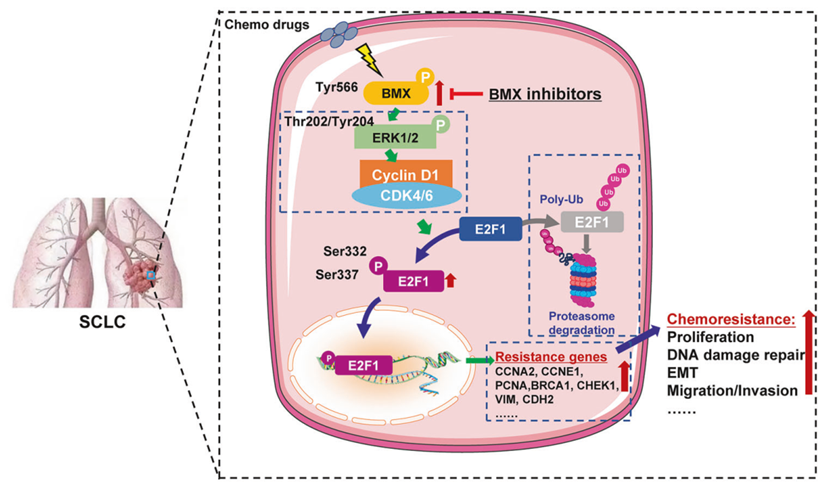
Mechanism model: Small-molecule inhibitor targets BMX-E2F1 axis to reverse SCLC chemoresistance. (Image by QI Shuang)
<関連情報>
- https://english.hf.cas.cn/nr/bth/202604/t20260428_1158200.html
- https://www.nature.com/articles/s41392-026-02644-1
MX阻害はERK1/2-サイクリンD1/CDK4/6経路を介してE2F1を安定化させることにより、小細胞肺癌の化学療法耐性を克服する BMX inhibition overcomes small cell lung cancer chemoresistance by stabilizing E2F1 via ERK1/2-Cyclin D1/CDK4/6 axis
Ting Wu,Shuang Qi,Chenliang Shi,Chao Wu,Qingwang Liu,Chen Hu,Jie Hu,Aoli Wang,Jing Liu,Ziping Qi,Wenchao Wang & Qingsong Liu
Signal Transduction and Targeted Therapy Published:08 April 2026
DOI:https://doi.org/10.1038/s41392-026-02644-1
Abstract
Chemotherapy resistance remains a critical bottleneck limiting its clinical efficacy in small cell lung cancer (SCLC), with its core mechanisms and targeted intervention strategies urgently requiring breakthroughs. Our study revealed that the BMX (bone marrow tyrosine kinase on chromosome X)-E2F1 (E2F transcription factor 1) axis is a pivotal regulator of chemoresistance in SCLC. Synchronous upregulation of phosphorylated BMX (Tyr566) and E2F1 was observed in SCLC tissues and cells. Mechanistically, BMX stabilized E2F1 via the ERK1/2 (extracellular signal-regulated kinase 1/2)-Cyclin D1/CDK4/6 (cyclin-dependent kinase 4/6) signaling axis, phosphorylating E2F1 at Ser332/337 and inhibiting its degradation via the ubiquitin-proteasome pathway. Inhibition or knockdown of BMX reduced E2F1 stability, promoting its degradation and reversing chemoresistance. E2F1 knockdown decreased the expression of genes associated with cell cycle regulation, migration, invasion, and DNA repair, further sensitizing chemoresistant SCLC cells to cisplatin. We also discovered IHMT-15137, a potent and selective BMX inhibitor. In vitro studies using SCLC patient-derived cells (PDCs)/patient-derived organoids (PDOs) and chemoresistant cell lines revealed that IHMT-15137, combined with cisplatin, synergistically induced cell cycle arrest, apoptosis, and DNA damage while suppressing cell migration and invasion. In vivo xenograft models demonstrated that the combination significantly inhibited tumor growth without causing significant toxicity. Our findings reveal the molecular mechanisms of SCLC chemoresistance and suggest potential therapeutic strategies targeting the BMX-E2F1 axis to overcome this challenge.