2026-03-13 東北大学
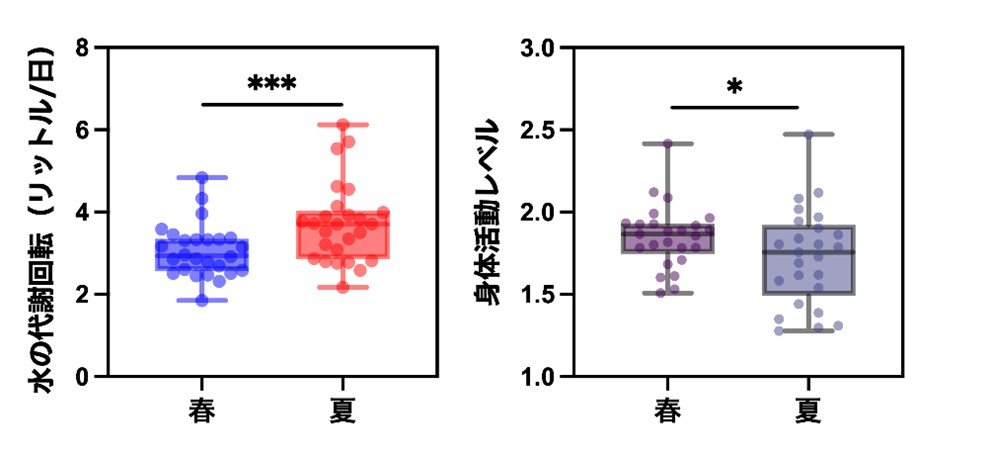
図1. 高齢者における春と夏の水の代謝回転と身体活動の比較
春(平均19℃)と夏(平均29℃)における体内の水の代謝回転量と身体活動量を比較したものです。夏には水の代謝回転量が増加する一方で、身体活動量は低下する傾向がみられました。
<関連情報>
- https://www.tohoku.ac.jp/japanese/2026/03/press20260313-02-water.html
- https://www.tohoku.ac.jp/japanese/newimg/pressimg/tohokuuniv-press20260313_02web_water.pdf
- https://www.nature.com/articles/s41598-026-38832-w
自由生活を送る高齢者の春から夏にかけての水分補給、水分必要量、エネルギーバランス:二重標識水研究 Hydration, water requirements, and energy balance from spring to summer in free-living older adults: a doubly labelled water study
Hyeon-Ki Kim,Yui Nakayama,Tsukasa Yoshida,Keiichi Yokoyama,Yuya Watanabe,Aya Itoi,Eiichi Yoshimura,Hinako Nanri,Rie Tsutsumi,Yumi Nakamura,Norifumi Tateishi,Rei Ono,Misaka Kimura,Hiroyuki Sagayama & Yosuke Yamadafor the Kyoto-Kameoka Study Group
Scientific Reports Published:19 February 2026
DOI:https://doi.org/10.1038/s41598-026-38832-w Unedited version
Abstract
The escalating effects of climate change, particularly global warming, are posing an increasing burden on human health. Older adults are particularly susceptible to the impact of extreme heat. Adequate water intake is essential to prevent dehydration in hot environments. Therefore, it is important to understand water turnover (WT) and intake. WT of older adults in hot environments remains unknown. This study aimed at investigating the seasonal effects on WT, total energy expenditure (TEE), and physical activity using doubly labeled water (DLW) and a triaxial accelerometer. A total of 26 older Japanese adult males and females aged ≥ 65 years participated in the study. WT and TEE were measured using DLW in May and August 2012. The mean values of maximum, mean, and minimum temperatures and mean humidity of the measurement days were 24 °C, 19 °C, 14 °C, and 57% in May (spring) and 35 °C, 29 °C, 25 °C, and 66% in August (summer) 2012, respectively. The mean (standard deviation, SD) age of the participants was 73.7 (5.4) years. Total body water increased significantly from 31.1 (4.6) to 31.9 (5.2) kg (+ 0.8 kg, P = 0.009) from May to August. TEE decreased significantly from 2271 (280) to 2123 (470) kcal/day (- 149 kcal/d, P = 0.036), while WT increased significantly from 2.939 (0.625) to 3.579 (0.943) L/day (+ 0.640 L/d, P < 0.001). WT increased by 640 mL/day during summer compared to that during spring, when the average temperature was 19 °C. Our findings indicate that WT increases during hot weather in older adults, reflecting seasonal adaptation.