2026-03-19 東北大学
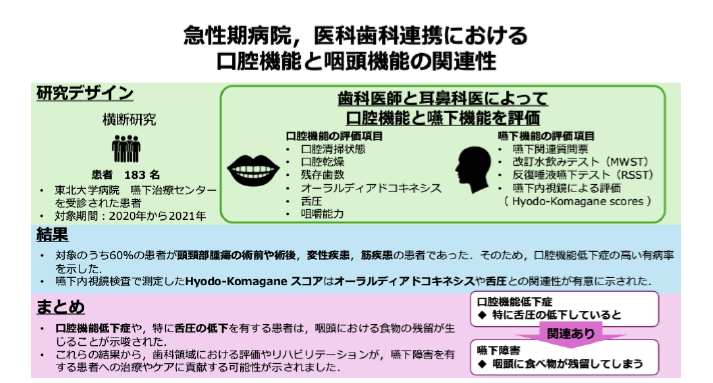
図1. 急性期病院、医科歯科連携における口腔機能と咽頭機能の関連性
<関連情報>
- https://www.tohoku.ac.jp/japanese/2026/03/press20260319-00-oral.html
- https://www.tohoku.ac.jp/japanese/newimg/pressimg/tohokuuniv-press20260319_00web_Oral.pdf
- https://onlinelibrary.wiley.com/doi/10.1111/joor.70176
急性期病院における歯科医療連携患者の口腔機能と咽頭機能の関連性 Association Between Oral and Pharyngeal Functions in Patients in Medical-Dental Cooperation at an Acute Hospital
Ryo Tagaino, Kana Saijo, Naru Shiraishi, Takamasa Komiyama, Kuniyuki Izumita, Takuma Hisaoka, Ai Hirano, Jun Ota, Yukio Katori, Toru Ogawa, Keiichi Sasaki, Nobuhiro Yoda, Hiroshi Egusa, Shigeto Koyama
Journal of Oral Rehabilitation Published: 08 March 2026
DOI:https://doi.org/10.1111/joor.70176
ABSTRACT
Background
Recent studies have focused on oral frailty and hypofunction, and their relationship with swallowing function and dysphagia. These play especially important roles in patients with dysphagia in medical-dental cooperation at acute hospitals.
Objective
This study aimed to assess oral frailty, in terms of nutritional intake by evaluating oral and swallowing functions simultaneously, in patients consulting at an acute hospital.
Methods
This cross-sectional study was conducted at the Center for Dysphagia of Tohoku University Hospital and involved a comprehensive survey of 183 patients. Their oral function and oral status were evaluated, which included factors such as poor oral hygiene, oral dryness, tongue-lip motor function, tongue pressure, and masticatory performance. Additionally, swallowing status was evaluated using various methods, including a questionnaire related to swallowing, Hyodo–Komagane score, modified water-swallowing, and repetitive saliva swallowing tests. This thorough approach ensured the validity and reliability of our findings.
Results
Approximately 60% of patients had head and neck tumours, degenerative diseases, and muscular diseases. Therefore, a high prevalence of oral hypofunction was observed. Furthermore, since 41.5% of patients had limited tongue movement, a characteristic correlation existed between the oral diadochokinesis and Hyodo–Komagane score.
Conclusion
These results suggest that oral dryness score, oral diadochokinesis, and tongue pressure are associated with oral hypofunction and dysphagia. Additionally, patients with hypofunction and decreased tongue pressure may have hypopharyngeal residuals. The medical-dental cooperation in an acute hospital allows for the simultaneous assessment of oral and swallowing functions. This suggests a potential to contribute to the practice of safe oral intake and appropriate rehabilitation.