
2026-05-18 京都産業大学
<関連情報>
- https://www.kyoto-su.ac.jp/news/news-002947.html
- https://www.kyoto-su.ac.jp/mt_uploads/20260518_press01.pdf
- https://www.nature.com/articles/s41467-026-72673-5
クロストリジウムのリボソーム停止ペプチドCliMの多様な翻訳アレストメカニズム Diverse mechanisms of translation arrest by a Clostridia ribosome stalling peptide CliM
Mayu Yoshida,Felix Gersteuer,Ole Berendes,Keigo Fujiwara,Haaris A. Safdari,Helge Paternoga,Hiraku Takada,Nozomu Obana,Helmut Grubmüller,Lars V. Bock,Daniel N. Wilson & Shinobu Chiba
Nature Communications Published:18 May 2026
DOI:https://doi.org/10.1038/s41467-026-72673-5
Abstract
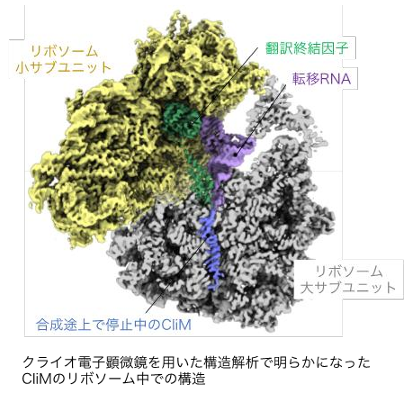
Ribosome arrest peptides undergo programmed translational stalling in response to changes in the cellular environment to feedback-regulate gene expression. CliM, an arrest peptide in Clostridia, is encoded upstream of the YidC membrane protein insertase gene, but its function and mechanism remain unclear. Here we show that CliM monitors YidC activity to maintain adequate cellular YidC capacity. Interestingly, Clostridium kluyveri CliM induces elongation arrest at multiple sense codons, whereas Clostridioides difficile CliM causes termination arrest. Cryo-EM-based structural and mutational analyses demonstrate that C. difficile CliM adopts multiple α-helices within the nascent polypeptide exit tunnel, where it forms extensive arrest-essential interactions with the ribosome. The residue immediately N-terminal to the stalling site contributes to arrest by sterically interfering with full accommodation of the release factor or aminoacyl-tRNA in the A-site. Molecular dynamics simulations suggest that membrane insertion of CliM induces sequential unwinding of these α-helical structures and relocation of the penultimate residue, thereby triggering arrest release. These findings provide a unified mechanistic framework that explains the distinct arrest behaviors of CliM homologs.

