2026-03-26 東北大学
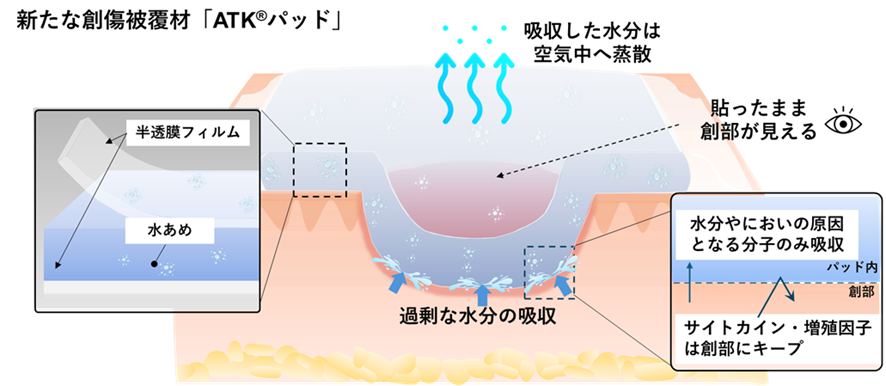
図1. 新しい創傷被覆材の構造と特徴
<関連情報>
- https://www.tohoku.ac.jp/japanese/2026/03/press20260326-01-healing.html
- https://www.tohoku.ac.jp/japanese/newimg/pressimg/tohokuuniv-press20260326_web01_healing.pdf
- https://www.nature.com/articles/s41598-026-41264-1
透明な浸透性創傷被覆材ATKPADは、治癒過程を促進し、低酸素依存性の炎症反応を調節する A transparent osmotic wound dressing ATKPAD promotes the healing process and regulates hypoxia-dependent inflammatory responses
Yuki Sato,Eiki Ito,Hiromasa Tanno,Takashi Kanno,Ryuto Arai,Koji Sato,Ayato Kaneta,Wakana Kamada,Ikue Sone,Ko Sato,Shinyo Ishi,Toshiro Imai,Hiromu Matsunaga,Tetsuji Aoyagi,Yoshimichi Imai,Yoshiyuki Adachi & Emi Kanno
Scientific Reports Published:06 March 2026
DOI:https://doi.org/10.1038/s41598-026-41264-1 Unedited version
Abstract
The inflammatory response after skin injury initiates wound healing by promoting the release of cytokines and growth factors essential for tissue repair. Modern wound dressings promote healing by maintaining a moist, hypoxic environment. ATKPAD is a novel wound dressing that accelerates healing developed by Okamoto Industries, Inc. Composed of reduced starch syrup and a semi-permeable membrane, it was launched in Japan as a Class III medical device in 2024. Transparent ATKPAD allows wound visibility and absorbs exudate in a molecular-weight-dependent manner, with its semi-permeable membrane retaining larger molecules, like cytokines, while letting small molecules pass through osmotic effects rather than specific binding. However, the detailed molecular and cellular mechanisms of ATKPAD remain unclear. In this study, we examined its effect on full-thickness excisional wound healing. We analyzed the in vitro permeability of cytokines and growth factors and evaluated granulation tissue formation, angiogenesis, neutrophil infiltration, and cytokine and growth factor production in vivo. We observed an increase in cytokines and growth factors alongside accelerated wound healing with ATKPAD. Its application enhanced granulation tissue formation and neutrophil infiltration, accompanied by increased expression of Hif1α. These findings suggest that ATKPAD promotes wound healing by creating a hypoxic microenvironment that enhances early-phase inflammation. (Word count: 200).