
2026-09-01 国立長寿医療研究センター
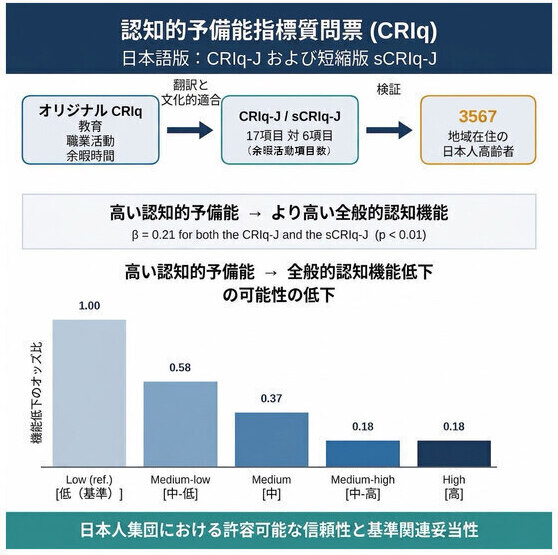
図 研究結果の概要
<関連情報>
- https://www.ncgg.go.jp/ri/report/20260901.html
- https://onlinelibrary.wiley.com/doi/10.1111/ggi.70803
認知予備能指数質問票の日本語翻訳研究 The Japanese Translation Study of the Cognitive Reserve Index Questionnaire
Osamu Katayama, Ryo Yamaguchi, Daiki Yamagiwa, Shoma Akaida, Takahiro Shimoda, Chika Nakajima, Ayuka Kawakami, Kenji Harada, Sho Nakakubo, Fumio Sakimoto, Soichiro Matsuda, …
Geriatrics & Gerontology International Published: 17 August 2026
DOI:https://doi.org/10.1111/ggi.70803
ABSTRACT
Background
The cognitive reserve index questionnaire (CRIq) is widely used to quantify cognitive reserve (CR), but a validated Japanese version is lacking. This study aimed to translate and culturally adapt the CRIq and its short version (s-CRIq) into Japanese (CRIq-J and sCRIq-J) and to evaluate their reliability and criterion-related validity.
Methods
Following international guidelines for cultural adaptation and translation, we translated and culturally adapted the CRIq and s-CRIq into Japanese. The study participants were 3567 community-dwelling Japanese older adults from a large-scale cohort. Global cognitive performance was assessed with the composite score of the National Center for Geriatrics and Gerontology–Functional Assessment Tool and global cognitive impairment (GCI) was defined as a mini-mental state examination score ≤ 23. Internal consistency was assessed using Cronbach’s alpha. Multiple and logistic regression analyses were performed to examine associations between CRIq-J and sCRIq-J total scores and global cognitive performance, including GCI.
Results
Cronbach’s alpha coefficients were 0.58 for the CRIq-J and 0.48 for the sCRIq-J, reflecting the multidimensional nature of life-course experiences. After adjusting for age and sex, higher scores on both the CRIq-J (β = 0.21, 95% CI: 0.18–0.24, p < 0.001) and sCRIq-J (β = 0.21, 95% CI: 0.17–0.25, p < 0.001) were significantly associated with superior cognitive performance. Furthermore, higher CRI levels were associated with a significantly lower likelihood of GCI.
Conclusions
The CRIq-J and sCRIq-J demonstrated acceptable reliability and robust criterion-related validity in a Japanese population. These standardized tools represent a significant milestone for future CR research and the development of dementia prevention strategies in Japan.

