
2026-04-06 東北大学
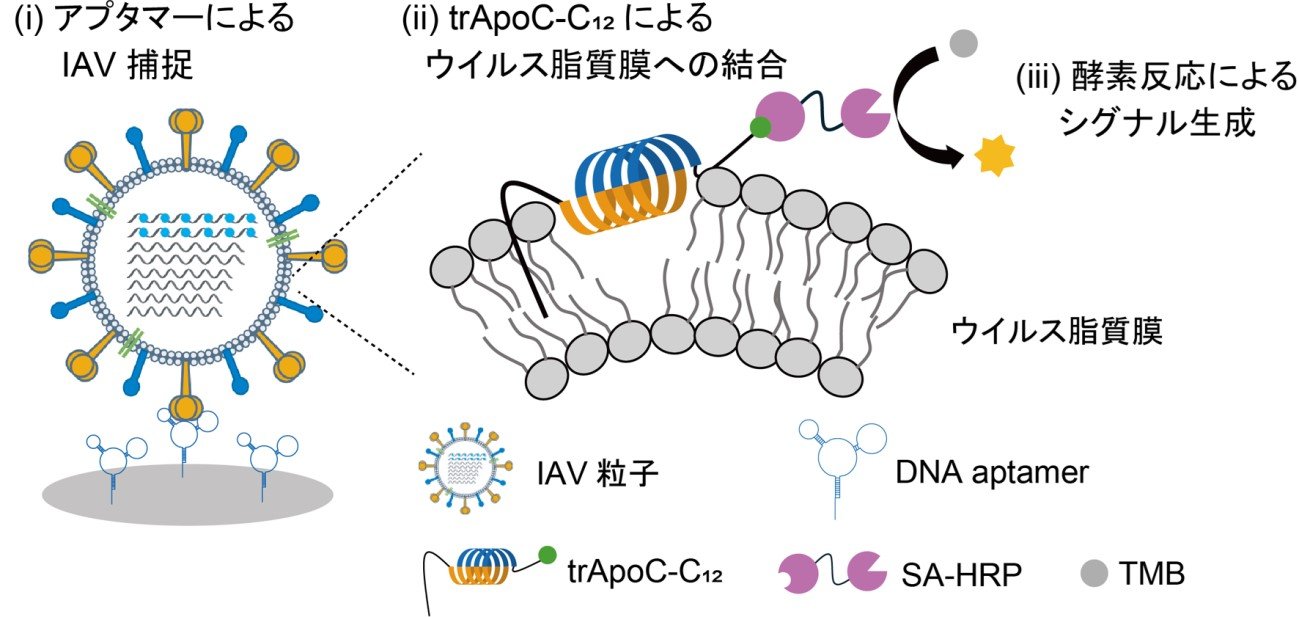
図1. 本手法の概略図:(i) 基板に固定化したHAを認識するDNAアプタマーによるIAV捕捉、(ii) ウイルス脂質膜に結合するtrApoC-C12リガンドへの結合(iii) HRP部位によるTMB酸化反応による発色・検出
<関連情報>
- https://www.tohoku.ac.jp/japanese/2026/04/press20260406-02-virus.html
- https://www.tohoku.ac.jp/japanese/newimg/pressimg/tohokuuniv-press20260406_02web_virus.pdf
- https://pubs.acs.org/doi/10.1021/acssensors.6c00241
インフルエンザAウイルス粒子の比色サンドイッチアッセイのための、ウイルス膜を標的とする両親媒性らせん状ペプチドリガンド Viral Membrane-Targeting Amphipathic Helical Peptide Ligands for Colorimetric Sandwich Assays of Influenza A Virus Particles
Kota Matsumoto,Yusuke Sato,Yusaku Hatanaka,Satoshi Kurihara,Yoshitaka Sato,Arihiro Narita,and Seiichi Nishizawa
ACS Sensors Published: April 2, 2026
DOI:https://doi.org/10.1021/acssensors.6c00241
Abstract
Viral membrane-binding amphipathic helical (AH) peptides were explored as detection ligands in the sandwich-type colorimetric assay for selective detection of target influenza A virus (IAV) particles, combined with DNA aptamer-mediated capturing on a microplate. A truncated AH peptide from the C-terminal of apolipoprotein A-I (trApoC) was conjugated with a lipophilic tail (C12) to construct the detection ligand capable of binding to highly curved viral membranes via hydrophobic insertion. The resulting trApoC-C12 can efficiently bind to viral membranes of IAV particles captured by the immobilized aptamer. Horseradish peroxidase (HRP)-conjugated trApoC-C12 exhibited a strong and selective colorimetric response toward IAV particles (limit of detection (LOD) = 9.4 × 10⁷ particles/mL) over recombinant hemagglutinin (HA) proteins and other enveloped viruses. Unlike conventional antibody-based ELISAs that detect viral proteins, this assay achieves IAV particle-level selectivity by exploiting viral membrane binding as the recognition mechanism. Our assay was thus shown to be applicable to the assessment of infectious titers of IAV. Furthermore, the detection sensitivity could be remarkably improved by 3.4-fold (LOD = 2.8 × 10⁷ particles/mL) by coupling trApoC-C12’s binding with the hybridization chain reaction (HCR) on the viral membranes. The developed assay is expected to be a powerful and straightforward platform for the practical detection and quantification of enveloped virus particles.
