2026-04-10 東京科学大学
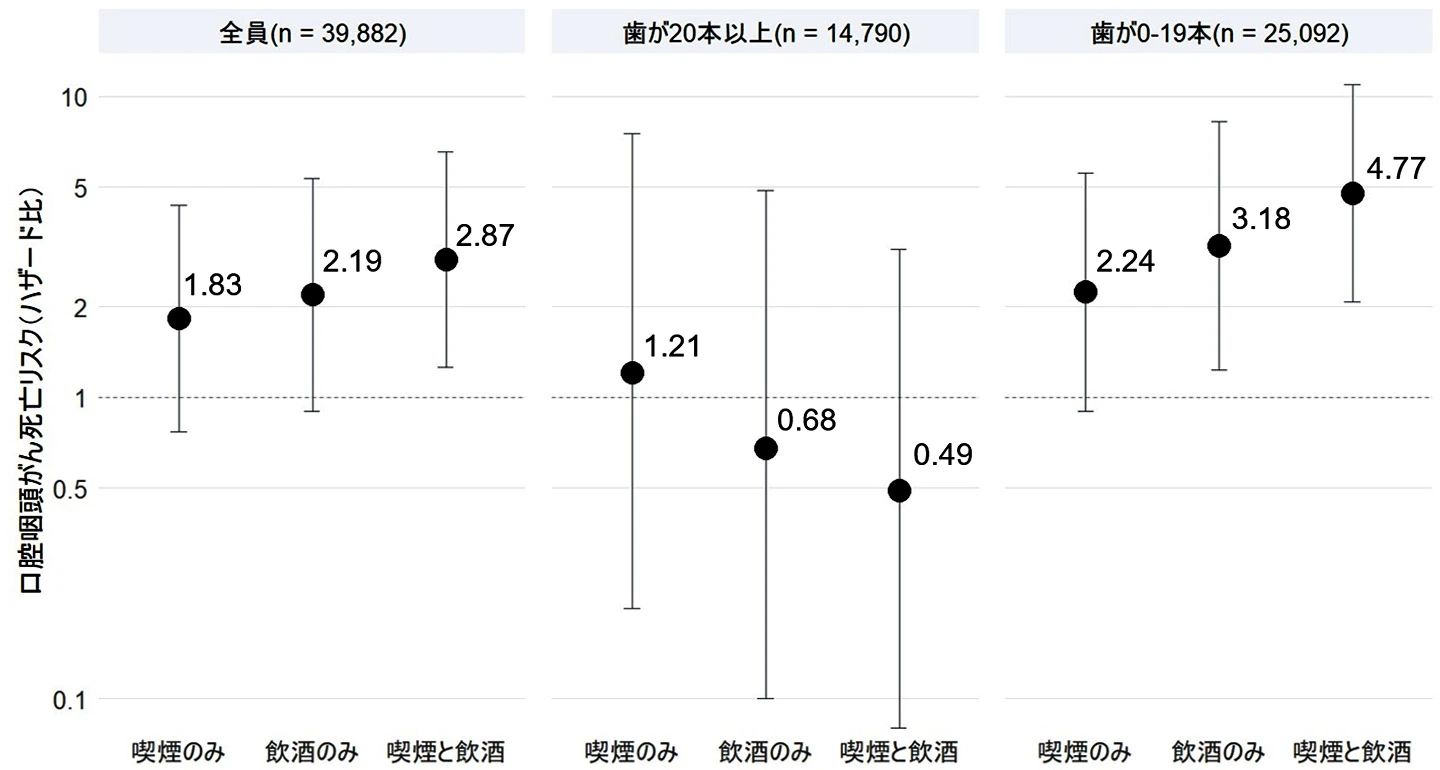
※非喫煙・非飲酒者を基準とした場合
図1. 飲酒・喫煙歴および歯数と、その後12年間における口腔咽頭がん死亡リスクとの関連
<関連情報>
- https://www.isct.ac.jp/ja/news/5li45551k7vc#top
- https://www.sciencedirect.com/science/article/pii/S1368837526000904
喫煙、飲酒、歯の喪失と口腔咽頭がんによる死亡リスク Smoking, drinking, tooth loss and risk of oral–pharyngeal cancer mortality
Sakura Kiuchi, Yusuke Matsuyama, Kenji Takeuchi, Taro Kusama, Toshiyuki Ojima, Masashige Saito, Katsunori Kondo, Hiroyuki Harada, Ken Osaka, Jun Aida
Oral Oncology Available online: 16 March 2026
DOI:https://doi.org/10.1016/j.oraloncology.2026.107937
Highlights
- We investigated the association between smoking, alcohol consumption, and the number of teeth for oral and pharyngeal cancer mortality.
- Both smoking and drinking were associated with a higher risk of oral and pharyngeal cancer mortality, particularly among those with fewer teeth.
- Monitoring these high-risk populations in both clinical and community settings is necessary.
Abstract
Background
Smoking and alcohol consumption are major risk factors for oral and pharyngeal cancer (OPC) mortality. However, the interaction between these risks and tooth loss, as an indicator of cumulative consequences of oral health disadvantages, has not been investigated.
Methods
We used data from the Japan Gerontological Evaluation Study, which included functionally independent Japanese adults aged ≥ 65 years. The baseline survey was conducted in 2010 and followed up until 2022. The outcome was OPC mortality. The exposures were smoking, drinking, and the number of teeth. To estimate the hazard ratio (HR) and 95% confidence interval (CI) of OPC mortality, the Cox proportional hazards model was applied. We also assessed multiplicative and additive interactions by calculating the relative excess risk due to interaction (RERI).
Results
A total of 39,882 participants were included (men: 46.8%). The mean age at baseline was 73.7 years (SD = 6.0). The mean follow-up was 3,689 days. Among them, 0.2% had OPC mortality. Both smoking and drinking were associated with a higher risk of OPC mortality compared with none (HR, 2.87; 95%CI, 1.26–6.55). Those with 0–19 teeth were associated with a higher risk of OPC mortality than those with ≥ 20 teeth (HR, 1.96; 95%CI, 1.11–3.46). Interaction analysis showed higher OPC mortality risk among those with both smoking and drinking and 0–19 teeth (multiplicative interaction; HR, 5.02; 95%CI, 1.09–23.21, additive interaction; RERI, 2.97; 95%CI, 0.06–5.88).
Conclusions
Both smoking and drinking were associated with a higher risk of OPC mortality, particularly among those with fewer teeth.