2026-04-10 琉球大学
<関連情報>
- https://www.u-ryukyu.ac.jp/news/77395/
- https://www.jstage.jst.go.jp/article/circj/advpub/0/advpub_CJ-25-1182/_article/-char/en
マウスにおけるNO合成酵素の存在の有無に依存したテストステロンの心血管作用の二面性 Two Faces of Cardiovascular Actions of Testosterone Dependent on the Presence or Absence of Nitric Oxide Synthases in Mice
Shotaro Higa, Mayuko Sakanashi, Masato Tsutsui , Takashi Tasaki, Akihide Tanimoto, Yuji Taira, Hiroaki Shimokawa, Yukio Kuniyoshi, Kojiro Furukawa
Circulation Journal Published: April 03, 2026
DOI:https://doi.org/10.1253/circj.CJ-25-1182
Abstract
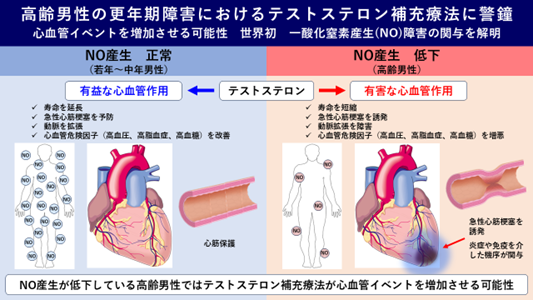
Background: Previous clinical studies reported that testosterone replacement therapy unexpectedly increased cardiovascular (CV) events in elderly men, through an unknown underlying mechanism. Because nitric oxide (NO) production is reduced in elderly men, we hypothesized that testosterone exerts harmful CV effects under reduced NO production, and examined this hypothesis using a 2/3 nephrectomized triple neuronal/inducible/endothelial NO synthases (NOS)-knockout (NX-TKO) mouse model that causes death from myocardial infarction (MI).
Methods and Results: The survival rate was markedly worse in male NX-TKO mice than in male NX-wild-type (NX-WT) mice. Orchiectomy (ORX) significantly aggravated the survival rate in NX-WT mice, but significantly improved it in NX-TKO mice. In the NX-TKO-ORX mice, long-term subcutaneous treatment with testosterone significantly deteriorated the survival rate, the incidence of MI, and CV risk factors. Furthermore, testosterone-induced aortic relaxations were significantly more impaired in the TKO than in the WT mice. RNA sequencing in the hearts of TKO-ORX mice without and with testosterone treatment indicated possible involvements of immunity- and inflammation-mediated mechanisms in the harmful CV effects of testosterone.
Conclusions: These results provide the first evidence that testosterone exerts harmful CV effects, including shorter survival, increased incidence of MI, impaired arterial relaxation, and exacerbated cardiovascular risk factors, in the absence of NOS in mice. Our findings may explain in part why testosterone replacement therapy increases CV events in elderly men.