
2026-04-23 ミュンヘン大学(LMU)
<関連情報>
- https://www.lmu.de/en/newsroom/news-overview/news/promising-cell-model-for-dementia-research-6c948bb0.html
- https://www.science.org/eprint/5H5YDPCPFQ3KBUSNE2A7/full
4Rタウアイソフォーム発現のために遺伝子操作されたヒトiPSCタウオパチーモデルは、内因的に後期段階の神経細胞タウ病理を発症する A human iPSC model of tauopathies engineered for 4R tau isoform expression endogenously develops late-stage neuronal tau pathology
Angelika Dannert, Nathalie Schulz, Julien Klimmt, Lea Knez, […] , and Dominik Paquet
Science Translational Medicine Published:8 Apr 2026
DOI:https://doi.org/10.1126/scitranslmed.adu9845
Editor’s summary
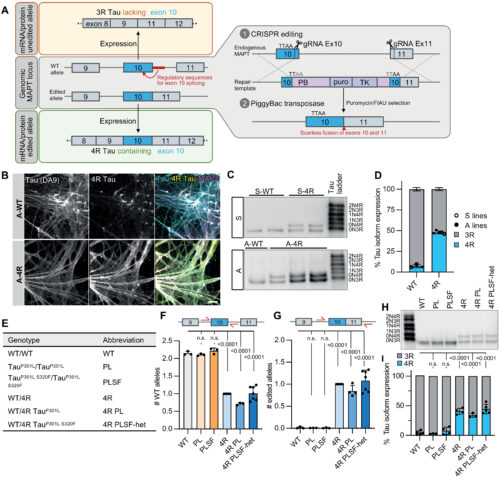
Human induced pluripotent stem cell (iPSC)–derived neurons are invaluable for the study of neurodegenerative diseases. However, the development of iPSC-derived models of late-stage tauopathy is hindered by reprogramming-induced cell rejuvenation, which is required for iPSC production but prevents the expression of certain developmentally regulated tau isoforms that are important for pathogenesis. Here, Dannert et al. used a gene editing approach to balance adult neuron-like 3R and 4R tau isoform expression from the endogenous MAPT locus in iPSC-derived neurons. Combining this approach with knockin of specific tau mutations produced neurons that developed features of late-stage pathology. Proof-of-concept experiments suggest that this cell model can also be used for in vitro testing of small molecules inhibiting tau aggregation, making it a useful tool for basic and translational research. —Daniela Neuhofer
Abstract
Tauopathies, such as Alzheimer’s disease and frontotemporal dementia, are common neurodegenerative diseases characterized by misfolding, hyperphosphorylation, and aggregation of tau. Molecular mechanisms underlying tauopathies are still poorly understood, which is in part due to a lack of human models autonomously developing major disease hallmarks. The formation of late-stage disease phenotypes may require adult tau isoform expression, which contributes to tau pathogenesis but is challenging to replicate in human stem cell–derived systems, thus impeding research on underlying mechanisms and drug development. Here, we show that induction of adult human brain–like 4R tau isoform expression enables cell-intrinsic formation of late-stage tauopathy hallmarks in induced pluripotent stem cell–derived neurons engineered to contain synergistic tau mutations without exogenous sources of tau pathology. Neurons accumulated seeding-competent and hyperphosphorylated tau in tangle-like structures. Furthermore, exclusive expression of mutant 4R in the absence of the 3R tau isoform disproportionately intensified pathology, resulting in abundant tau misfolding and aggregation. Last, we provide proof of principle that our model can be translationally applied both to test chemical disease modulators and evaluate human tau PET tracers. Collectively, our model corroborates the central role of 4R tau isoform expression for pathogenesis in human neurons and enables investigations to elucidate mechanisms underlying human tauopathy formation. Moreover, it may serve as a platform supporting urgently needed development of disease-modifying drugs.

