2026-04-24 名古屋工業大学,名古屋大学,東京大学
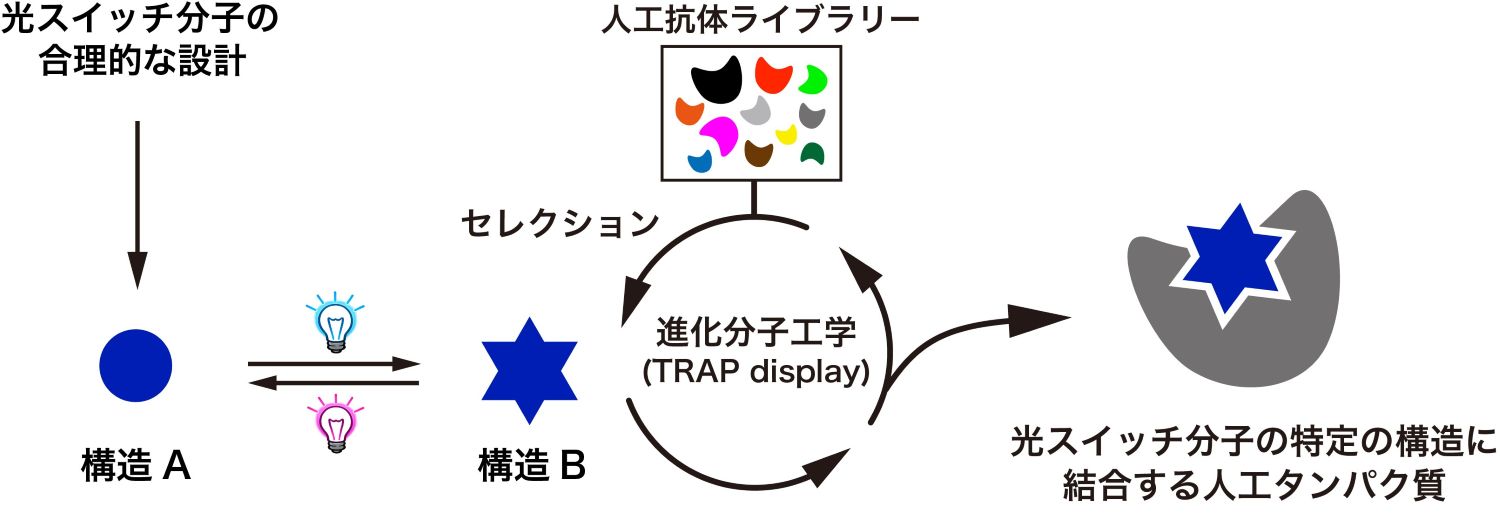
本研究の概念図
<関連情報>
- https://www.nitech.ac.jp/news/press/2026/13908.html
- https://www.nitech.ac.jp/mt_files/260423press_tsukiji.pdf
- https://www.nature.com/articles/s41557-026-02121-w
光応答性分子の合理的設計とそれらの人工タンパク質結合ペアの選択による、新規化学光遺伝学 De novo chemo-optogenetics through the rational design of photoresponsive molecules and selection of their artificial protein binding pairs
Tomoki Miyazaki,Tomoshige Fujino,Tatsuyuki Yoshii,Haruto Kosugi,Mamoru Funane,Naoya Murata,Kim Chung Nguyen,Satoru Nagatoishi,Kouhei Tsumoto,Gosuke Hayashi,Hiroshi Murakami & Shinya Tsukiji
Nature Chemistry Published:23 April 2026
DOI:https://doi.org/10.1038/s41557-026-02121-w
Abstract
Optical manipulation of proteins is central to probing and engineering cellular functions. However, existing optogenetic tools based on natural photoreceptors and chemo-optogenetic tools based on natural protein–ligand pairs are difficult to reconfigure for the desired photochemical and binding properties. Here we introduce a de novo approach for creating chemo-optogenetic tools. Instead of modifying pre-existing ligands, we first design a synthetic photoswitch with defined properties and then use mRNA display to select for artificial protein binders that recognize a specific photoisomer-dependent conformation. This bottom-up framework yields artificial photoswitch–protein binder pairs that enable precise optical control of diverse biological activities in mammalian cells, such as kinase and lipid signalling, G-protein-coupled receptor activation, gene expression and cell differentiation. The regulatory mode (sustained, reversible or repeatable) is readily programmed by adjusting light inputs. This de novo approach provides customizable synthetic photoswitch–protein binder pairs, expanding opportunities for optical protein manipulation in biological and biomedical applications.