2026-05-07 ワシントン州立大学(WSU)
Washington State Universityの研究チームは、人工知能(AI)を用いて野生動物追跡データの解析時間を数か月から数日へ短縮する技術を開発した。従来、GPS首輪やカメラトラップから得られる膨大な移動データや画像の整理・解析には多大な人的労力が必要だったが、新システムでは機械学習アルゴリズムが動物種識別や行動パターン解析を自動化する。これにより、研究者は個体移動、繁殖行動、生息域変化などを迅速に把握できるようになる。特に気候変動や土地利用変化による生態系影響をリアルタイムに近い形で監視できる点が重要視されている。また、絶滅危惧種保全や人間‐野生動物衝突の予測・管理への応用も期待される。研究チームは、AI活用により生態学研究の効率化と保全政策立案の高度化が進むと指摘している。
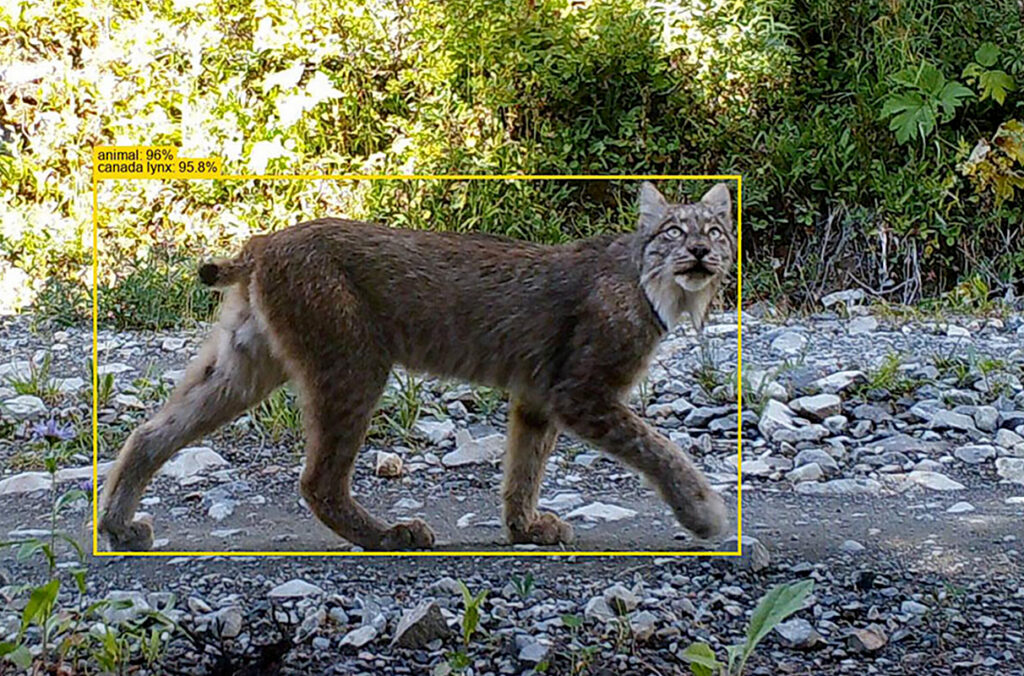
SpeciesNet’s AI prediction can be seen on an image of a lynx (photo courtesy of Mammal Spatial Ecology and Conservation Lab).
<関連情報>
- https://news.wsu.edu/press-release/2026/05/07/ai-cuts-wildlife-tracking-time-from-months-to-days/
- https://besjournals.onlinelibrary.wiley.com/doi/10.1111/1365-2664.70370
人工知能と人間の専門家によるカメラトラップ画像の識別は、類似した複数種の生息モデルを生成する Identification of camera trap images by artificial intelligence and human experts produces similar multi-species occupancy models
Daniel Thornton, Dan Morris, Travis King, Lucy Perera-Romero, Alissa Anderson, Rony Garcia-Anleu, Scott Fitkin, Carly Vynne
Journal of Applied Ecology Published: 06 May 2026
DOI:https://doi.org/10.1111/1365-2664.70370
Abstract
- The use of camera traps in ecology and conservation has expanded rapidly, but the time spent to accurately identify species in camera trap images remains a fundamental challenge that limits project scope and impact. Although artificial intelligence (AI) is often used to speed up image processing, a human review step is still standard practice to arrive at final species identifications. A potentially transformative next step is thus to remove humans entirely from the analysis chain and still produce accurate statistical models for subsequent inference across a wide diversity of species and regions.
- Here, we compare the output of Bayesian multi-species occupancy models derived from a complete AI workflow (no human review of images) with a general species classifier (SpeciesNet) to those from an expert (human) workflow, using large-scale camera datasets from three study areas and two distinct and diverse mid-large mammal assemblages. We apply several pre- and post-processing steps to the AI workflow to improve model agreement. We perform a comprehensive model comparison, assessing agreement in identified species–environment relationships and rates of occupancy and detection, and similarity of spatial projections of occupancy.
- We found that for most species of mammal, AI based models were remarkably similar to expert-based models, with some variability based on post-processing decisions. This agreement was robust, holding across multiple metrics of comparison (e.g. parameter estimates, precision, occupancy and detection rates), multiple study sites and at species and community levels. Similarity in model output occurred even in the presence of misclassification errors, suggesting our approach was resilient to some level of false negatives and positives. Substantial divergence in model output and subsequent inference, while rare, was most prevalent for rarely detected species.
- Synthesis and applications. The use of a global AI classifier to identify species and reproducible pre- and post-processing decisions makes our approach broadly applicable and particularly beneficial for national and international monitoring programs that collect large amounts of photo data on threatened, at risk, or management sensitive species and wildlife communities. A fully automated workflow will allow such programs to progress more rapidly from photo collection to analysis, inference and decision-making.