
2026-05-12 東京大学
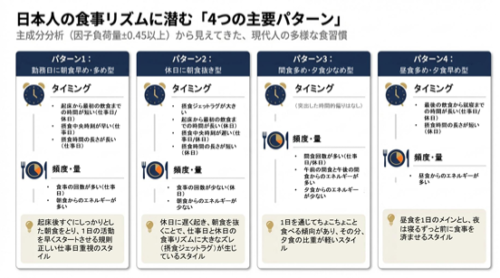
日本人の「食事リズム」には4つの型がある
<関連情報>
- https://www.u-tokyo.ac.jp/content/400289347.pdf
- https://www.cambridge.org/core/journals/british-journal-of-nutrition/article/identification-of-chrononutrition-behaviour-patterns-and-their-associations-with-sociodemographic-characteristics-diet-quality-and-obesity/BB83BFB815F658D1C39267CF4801261A
時間帯栄養行動パターンの特定と、社会人口統計学的特性、食事の質、肥満との関連性 Identification of chrono-nutrition behaviour patterns and their associations with sociodemographic characteristics, diet quality and obesity
Kentaro Murakami,Nana Shinozaki,M. Barbara E. Livingstone,Shizuko Masayasu andSatoshi Sasaki
British Journal of Nutrition Published:16 April 2026
DOI:https://doi.org/10.1017/S0007114526107090
Abstract
While chrono-nutrition behaviours are inter-related, few studies examined patterns of chrono-nutrition behaviours using a comprehensive set of these behaviours. This study aimed to identify chrono-nutrition behaviour patterns and examine their associations with sociodemographic characteristics, diet quality and obesity. This cross-sectional study included 1047 Japanese adults aged 20–69 years. Using 11-d diaries of eating, chrono-nutrition behaviours (such as frequency and timing of eating) were evaluated for workdays and non-workdays separately. Principal component analysis identified four patterns: ‘early, large breakfast on workdays’, ‘skipping breakfast on non-workdays’, ‘frequent snacking with small dinner’ and ‘early last eating with large lunch’. Female sex was associated with the ‘frequent snacking with small dinner’ and ‘early last eating with large lunch’ patterns; male sex was associated with the ‘skipping breakfast on non-workdays’ pattern. Age was positively associated with the ‘skipping breakfast on non-workdays’ and ‘early last eating with large lunch’ patterns. Having a full-time paid job was associated positively with the two patterns characterised mainly by breakfast but inversely with the remaining two patterns. After adjustment for potential confounders, none of the four patterns were significantly associated with diet quality (Healthy Eating Index-2020 score), general obesity (BMI ≥ 25 kg/m2) or abdominal obesity (waist circumference ≥ 90 cm for males; ≥ 80 cm for females). In conclusion, this study suggests that different chrono-nutrition behaviour patterns were differentially associated with sociodemographic characteristics, but not with diet quality or obesity. Further research is needed to clarify if the patterning approach is useful to comprehensively interrogate chrono-nutrition behaviours.

