
026-05-25 中国科学院(CAS)
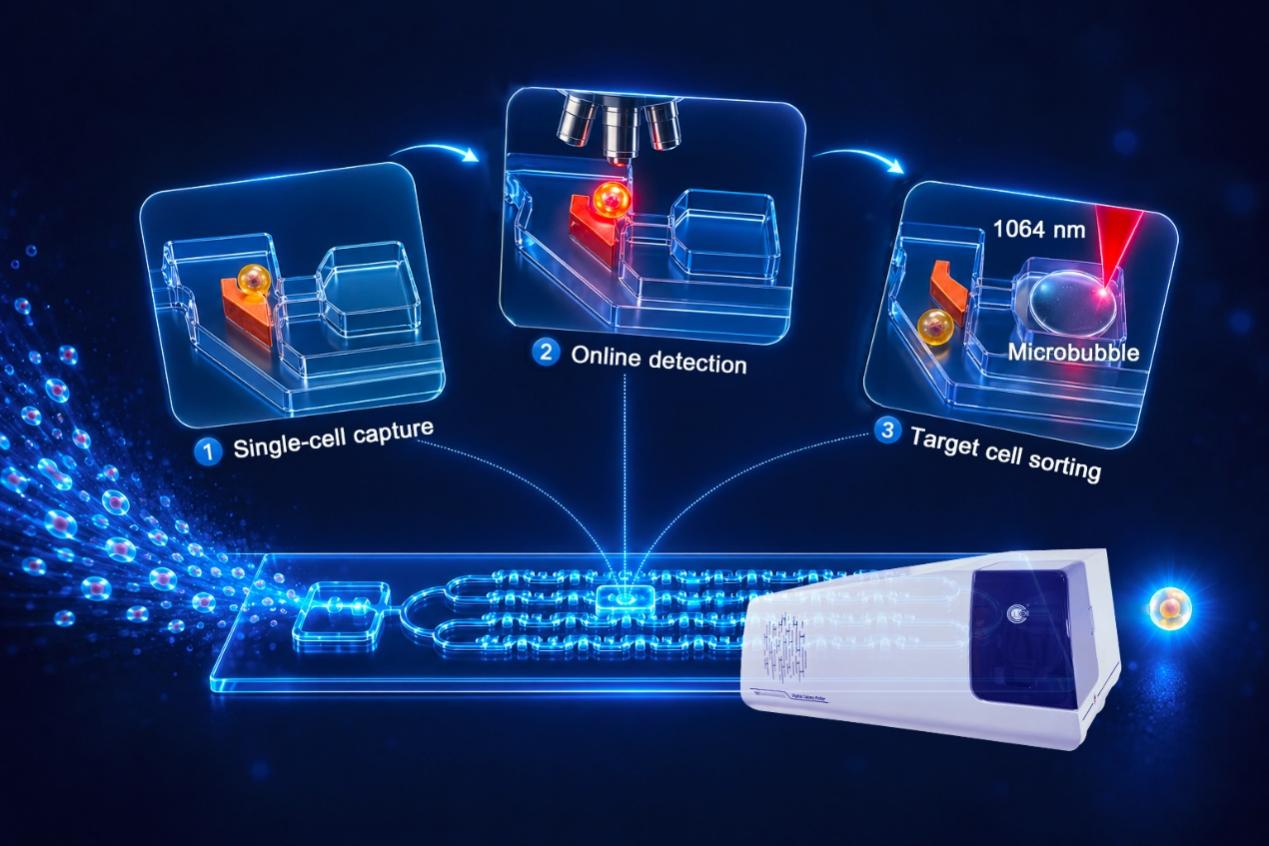
he Digital Colony Picker (DCP)-based platform integrates single-cell capture, real-time detection and target-cell sorting for mammalian cells (Image by LI Xiuyun)
<関連情報>
- https://english.cas.cn/newsroom/research-news/202605/t20260526_1159895.shtml
- https://www.sciencedirect.com/science/article/abs/pii/S0925400526006969
単一哺乳類細胞のハイスループット分析および選別を行うための統合プラットフォーム An integrated platform for high-throughput analysis and sorting of single mammalian cells
Xiuyun Li, Anle Ge, Zhidian Diao, Wenjie Zhao, Lingyan Kan, Sijun Luo, Wei Gao, Xixian Wang, Jian Xu, Bo Ma
Sensors and Actuators B: Chemical Available online 5 May 2026
DOI:https://doi.org/10.1016/j.snb.2026.140118
Highlights
- Integrated microfluidic platform combining cell capture, in situ incubation, online detection, and target sorting.
- Curved channels and micro-arrayed structures enabling high-efficiency capture of mammalian cells.
- Laser-induced microbubble technology for cost-effective and precise target cell sorting.
Abstract
Single mammalian cell heterogeneity plays a critical role in biological research. However, current microfluidic platforms for single-cell analysis still face the challenge of simultaneously achieving high-efficiency capture, cost-effective target cell sorting, and functional integration. To overcome these challenges, we developed a novel microfluidic platform for high-throughput single-cell analysis and sorting. This platform integrates multiple functions, including high-efficiency capture, online incubation, in situ detection, and target sorting. The chip employs a cost-effective polydimethylsiloxane-indium tin oxide (PDMS-ITO) glass configuration with arrayed capture microstructures, achieving average capture efficiency exceeding 93% for mammalian cells (RAW264.7, HCT116, and MCF7) across a size range of approximately 10–20 μm. The platform allows online incubation and artificial intelligence (AI)-assisted detection using both bright-field and fluorescent imaging. Cell viability rates consistently exceeded 80% after 24 h incubation and live/dead staining. A laser-induced microbubble strategy enabled precise releasing target single cells which were subsequently collected in a 96-well plate. In addition, the platform was applied to evaluate heterogeneity in reactive oxygen species (ROS) responses among macrophages, revealing intercellular differences under stimulation. This high-throughput, cost-effective platform combines high capture efficiency, advanced detection, and cell sorting functionality, demonstrating its utility for single mammalian cell heterogeneity studies and downstream applications.

