2026-05-26 東京農工大
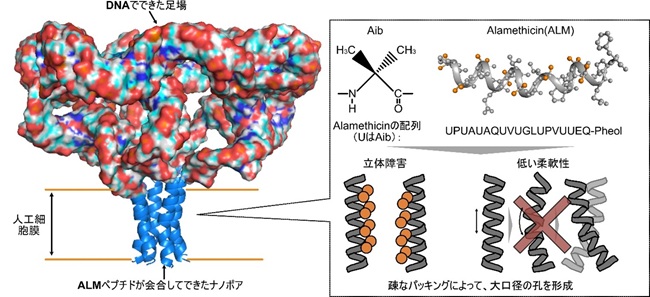
図1:設計したDNA–ペプチド複合ナノポア。DNAからなる足場構造によりペプチドの会合を支持しつつ、パッキングが過度に密となってポア径が小さくなることを防ぐため、ペプチド間相互作用の弱いペプチドであるalamethicin(ALM)を用いた。
(Z.Peng et al., Angewandte Chemie, 2026より引用)
<関連情報>
- https://www.tuat.ac.jp/outline/disclosure/pressrelease/2026/20260526_01.html
- https://onlinelibrary.wiley.com/doi/10.1002/ange.3311099
緩やかに充填されたペプチドによって実現された、大径DNA足場ナノポアによる単一分子センシング Large-Diameter DNA-Scaffolded Nanopores Enabled by Loosely Packed Peptides for Single-Molecule Sensing
Zugui Peng, Daisuke Noshiro, Shiroh Futaki, Ryuji Kawano
Angewandte Chemie Published: 22 May 2026
DOI:https://doi.org/10.1002/ange.3311099
ABSTRACT
Creating alternative nanopores is crucial for advancing single-molecule methodologies. Peptide nanopores scaffolded by DNA nanostructures have emerged as a promising class of chemically synthesizable nanopores with organized geometries. However, no such nanopores have yet achieved single-molecule detection due to size limitations. Here, we overcome this limitation by employing the alamethicin (ALM) peptide, based on the hypothesis that peptides with looser helix–helix packing are advantageous for constructing large-diameter nanopores. The resulting DNA–ALM nanopores exhibited long-lived open states and conductance values comparable to those of natural protein nanopores. To further enhance pore functionality, we introduced asymmetric electrostatic forces by harnessing the intrinsic helix dipole of ALM, which facilitated pore expansion and improved ion transport efficiency. This modification led to enhanced conductance levels and enabled single-molecule sensing of biomolecules, including DNA and peptides. Overall, this work demonstrates a generalizable strategy for constructing functional, chemically synthesizable nanopores, providing a foundation for programmable nanopore design and next-generation biosensing applications.