2026-05-26 東京大学,千葉大学,科学技術振興機構
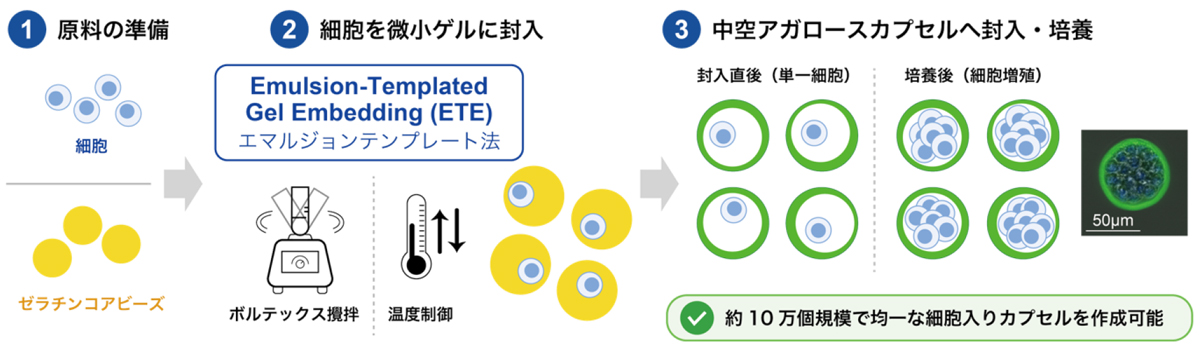
本研究で開発した細胞内包化手法(ETE)の概念図
<関連情報>
- https://www.rcast.u-tokyo.ac.jp/ja/news/release/20260526.html
- https://pubs.acs.org/doi/10.1021/acsbiomaterials.5c02129
エマルジョンを鋳型としたゲル埋め込み:マイクロ流体デバイスを用いない、ハイドロゲルマイクロカプセルへの細胞封入を大規模に実現する手法 Emulsion-Templated Gel Embedding: A Microfluidics-Free Method for Scalable Cell Encapsulation in Hydrogel Microcapsules
Natsuko Otaki,Yuki Goda,Pooja Shukla,Hiromi Kirisako,Yuko Yamagata,Megumi Matsuo,Kazuki Hattori,Eiryo Kawakami,and Sadao Ota
ACS Biomaterials Science & Engineering Published: May 21, 2026
DOI:https://doi.org/10.1021/acsbiomaterials.5c02129
Abstract
Encapsulation of single cells within uniform hydrogel microcapsules enables controlled three-dimensional culture and quantitative analysis of cell behavior; however, most existing approaches rely on microfluidic devices or complex encapsulation processes that limit accessibility. Here, we introduce emulsion-templated gel embedding (ETE), a microfluidics-free method that embeds cells within uniform gelatin beads using prefabricated bead templates to predefine capsule size prior to encapsulation. In ETE, cells and monodisperse gelatin beads are co-encapsulated within water-in-oil droplets generated by particle-templated emulsification (PTE), followed by thermal dissolution and re-gelation of the gelatin to form cell-laden beads of defined size. The resulting cell-laden gelatin beads can subsequently serve as templates for agarose shell formation, yielding hollow-core agarose microcapsules after gelatin dissolution. Cells encapsulated within microcapsules via ETE exhibit proliferation comparable to microfluidic-derived capsules, indicating that simplified processing does not compromise biological performance. By defining capsule size through prefabricated gelatin templates rather than relying on microfluidic flow control during encapsulation, ETE provides a practical and reproducible strategy for generating uniform hydrogel microcapsules for cell culture and biomedical applications.