2026-05-28 東北大学
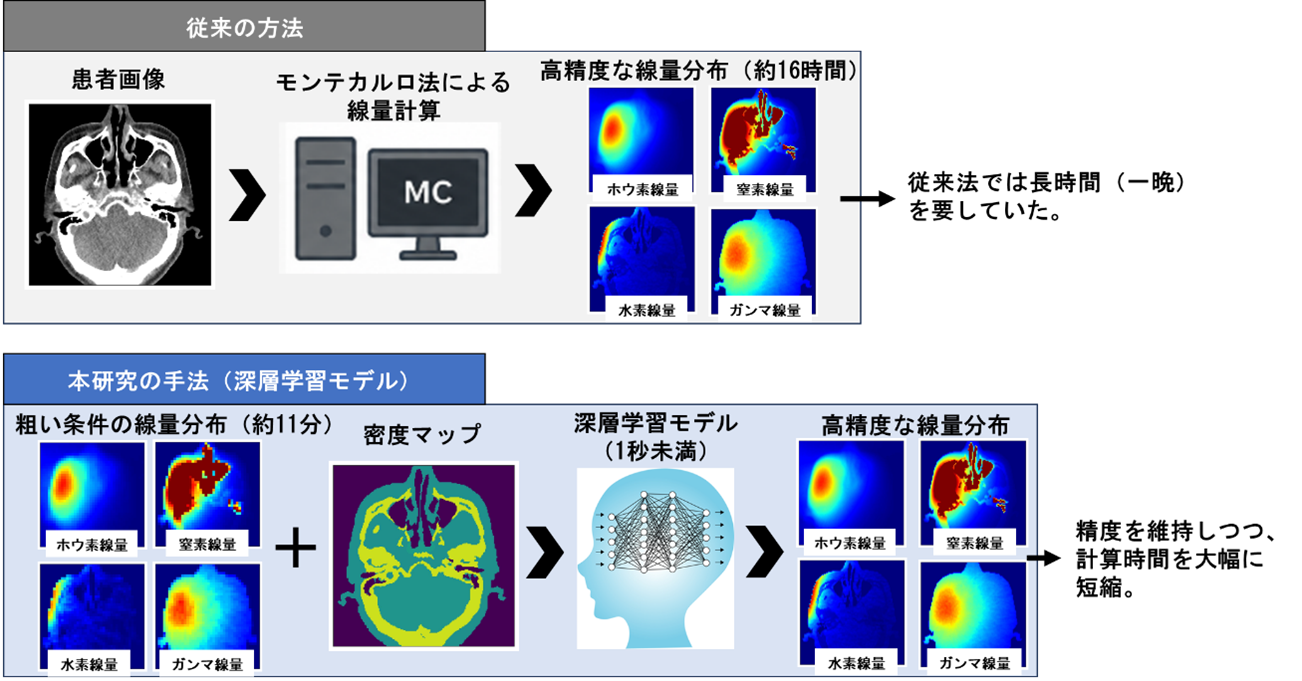
図1. 深層学習モデルを用いた高精度かつ高速なBNCT線量計算のワークフロー
<関連情報>
- https://www.tohoku.ac.jp/japanese/2026/05/press260528-03-bnct.html
- https://aapm.onlinelibrary.wiley.com/doi/10.1002/mp.70497
頭頸部がんに対するホウ素中性子捕捉療法における、実用的かつ高速な深層学習ベースの線量計算モデルの開発 Development of a practical and high-speed deep learning-based dose calculation model in boron neutron capture therapy for head and neck cancer
Ryohei Kato, Noriyuki Kadoya, Takahiro Kato, Akihiko Takeuchi, Shinya Komori, Keiichi Jingu, Yoshihiro Takai
Medical Physics Published: 26 May 2026
DOI:https://doi.org/10.1002/mp.70497
Abstract
Background
In boron neutron capture therapy (BNCT), Monte Carlo (MC) dose calculations are commonly employed because of the complicated neutron reactions. However, MC dose calculations are generally time-consuming. Recently, deep learning (DL)-based dose prediction/calculation has attracted increasing attention; however, the applications of DL models in BNCT are limited and have not been investigated extensively. In addition, there are no practical DL models that can be employed in BNCT clinical practice.
Purpose
We propose a practical DL model for head and neck cancers using a commercial treatment planning system (TPS) for BNCT. To increase the speed of the MC dose calculations, the proposed DL model converts the BNCT dose components calculated by the coarse dose calculation grid size and low statistical uncertainty in the MC calculation into the dose components calculated under the fine setting.
Methods
In this study, we considered 114 head and neck cancer patients who underwent accelerator-based BNCT at our center. Here, we randomly divided 102 patients for training/validation and 12 patients for testing. The BNCT dose components (i.e., boron, nitrogen, hydrogen, and gamma doses) were calculated for all patients using a commercial TPS for BNCT. We employed the hierarchically dense U-net and converted the BNCT dose components calculated by the coarse setting (grid size/uncertainty = 5 mm/10%) into doses calculated by the fine setting (2 mm/5%). In addition, a physical density map was added to the DL input to improve the conversion accuracy. Taking the fine dose as the ground truth, we evaluated the γ-passing rates with various criteria for each dose component of the coarse and DL doses. The calculation time was also measured in the fine, coarse, and DL doses.
Results
In the boron dose, the DL dose exhibited significantly higher γ-passing rates of ≥ 95% with a criterion of 1%/2 mm (dose difference/distance to agreement) than the coarse dose. In the nitrogen and hydrogen doses, the DL dose also demonstrated high γ-passing rates of 95.3% and 94.7% with a criterion of 5%/2 mm. The density map was effective for the hydrogen and nitrogen doses. In addition, the average γ-passing rate with the criterion of 3%/2 mm in the gamma dose achieved 96.2% for the DL dose. The average calculation times for the fine and coarse settings were 984.2 ± 470.2 min and 11.0 ± 2.9 min, respectively, and the average conversion time in the DL model was 0.091 ± 0.020 min.
Conclusions
In this study, the proposed DL model was developed to convert each dose component calculated in the coarse setting to the fine dose to increase the speed of commercial MC dose calculations in BNCT for head and neck cancers. The conversion speed from the coarse dose to the fine dose was considerably rapid, and its performance was highly accurate. The proposed DL model can provide accurate BNCT dose distributions at high speed, thereby contributing to improving the quality of BNCT treatment planning.