2026-06-02 合肥物質科学研究院(HFIPS)
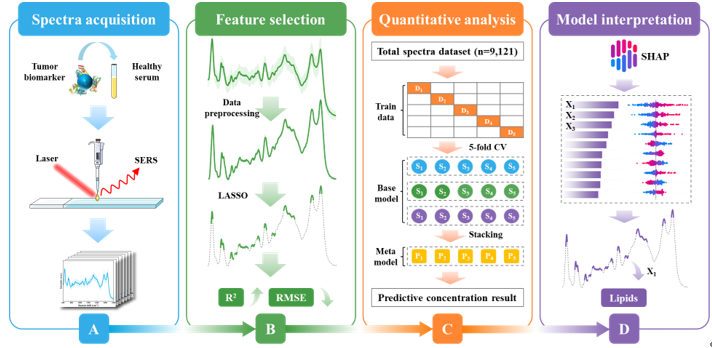
Workflow of SERS spectral acquisition, data processing, and ISEM-based quantitative analysis for serum tumor biomarkers. (WU Boyu)
<関連情報>
- https://english.hf.cas.cn/nr/rn/202606/t20260602_1160316.html
- https://pubs.acs.org/doi/10.1021/acs.analchem.5c04589
定量的 分析 の 複数 血清 腫瘍 バイオマーカー による 1 解釈可能 積み重ねられた アンサンブル モデル Quantitative Analysis of Multiple Serum Tumor Biomarkers by an Interpretable Stacked Ensemble Model
Boyu Wu,Jiawei Chen,Yanheng Huang,Pan Li,Qingmei Deng,Ronglu Dong,and Liangbao Yang
Analytical Chemistry Published: April 20, 2026
DOI:https://doi.org/10.1021/acs.analchem.5c04589
Abstract
Surface-enhanced Raman spectroscopy (SERS) offers exceptional sensitivity and specificity for biomolecular detection, particularly in analyzing serum tumor biomarkers. However, its application is hindered by spectral complexity and matrix interference. Although machine learning (ML) has shown promise in SERS data analysis, existing quantitative models for biomarker detection lack generalizability and interpretability. To address these challenges, we developed an interpretable stacked ensemble model (ISEM) that integrates feature selection, ensemble learning, and explainable artificial intelligence (XAI) for quantifying 12 serum tumor biomarkers. To ensure reliable quantitative analysis, we validated the acquired SERS data using uniform and reproducible Au nanoparticle substrates. Preprocessing, least absolute shrinkage, and selection operator (LASSO) feature selection were employed to establish a foundation for accurate quantification. Subsequently, 12 serum tumor biomarkers were quantified, demonstrating the superior performance of ISEM, which achieved a high predictive accuracy, with R2 values exceeding 0.9 for all biomarkers. Crucially, based on the quantitative results, we provided molecular-level interpretability for structure-spectrum correlations using Shapley additive explanations (SHAP), revealing how glycosylation reactions, matrix interference, and spectral overlap influence prediction accuracy. Furthermore, the capability of ISEM to quantify multiple biomarkers in unseen samples was confirmed through validation of its generalizability. Our study establishes an ensemble-driven, interpretable framework for quantitative biomarker analysis in a complex biological matrix, demonstrating significant potential for early cancer diagnosis and screening.