2026-06-03 カリフォルニア大学リバーサイド校(UCR)
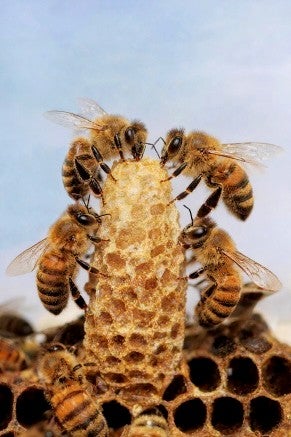
A queen cell with the royal guard attendants. (Yu Fang/UCR)
<関連情報>
- https://news.ucr.edu/articles/2026/06/03/how-honeybees-really-crown-their-queens
- https://www.nature.com/articles/s41586-026-10534-3
女王蜂の巣房の構造がミツバチの女王蜂の発育を左右する Queen cell architecture shapes honey bee queen development
Yu Fang (房宇),Beibei Ma (马贝贝),Xiaolu Jin (金晓露),Anja Buttstedt,Yahya Al Naggar,Kathy Darragh,Huafeng Tian (田华峰),Yin Zhu (朱荫),Guan Yang (杨冠),Yiying Yang (杨一颖),Yuan Huang (黄苑),Wanli Li (李万里),Rumeng Xu (徐如梦),Jianke Li (李建科),Fuliang Hu (胡福良),Liming Wu (吴黎明),Wenjun Peng (彭文君),Xiaofeng Xue (薛晓锋),Boris Baer & Kai Wang (王凯)
Nature Published:03 June 2026
DOI:https://doi.org/10.1038/s41586-026-10534-3
Abstract
Nest architecture in social insects is often viewed as a static structural component providing shelter or storage1. However, the extent to which these constructed environments actively shape biological traits remains poorly understood. Although the genetic and nutritional drivers of honey bee caste determination are well established2,3,4, the role for specialized queen cells has largely been attributed to spatial or structural factors, overlooking the influence of the physicochemical microenvironment5. Here we show that worker construction behaviour actively engineers a physicochemical niche that is crucial for queen development in honey bees. Queen cells exhibit distinct mechanical and chemical signatures that differ markedly from those of worker cells. These properties are not an accidental by-product of worker cell construction: workers construct queen cells deliberately and, in doing so, undergo task-specific physiological and transcriptomic reprogramming that enables precise engineering of these cell properties. Experimental manipulations of the rearing environment demonstrate that these physicochemical cues are causally required for normal queen development, functioning as a critical checkpoint that can profoundly influence an individual larva’s development. Together, our results establish a direct mechanistic link between social construction behaviour and developmental plasticity, revealing how an engineered environment can channel organismal fate.