2026-06-03 中国科学院(CAS)
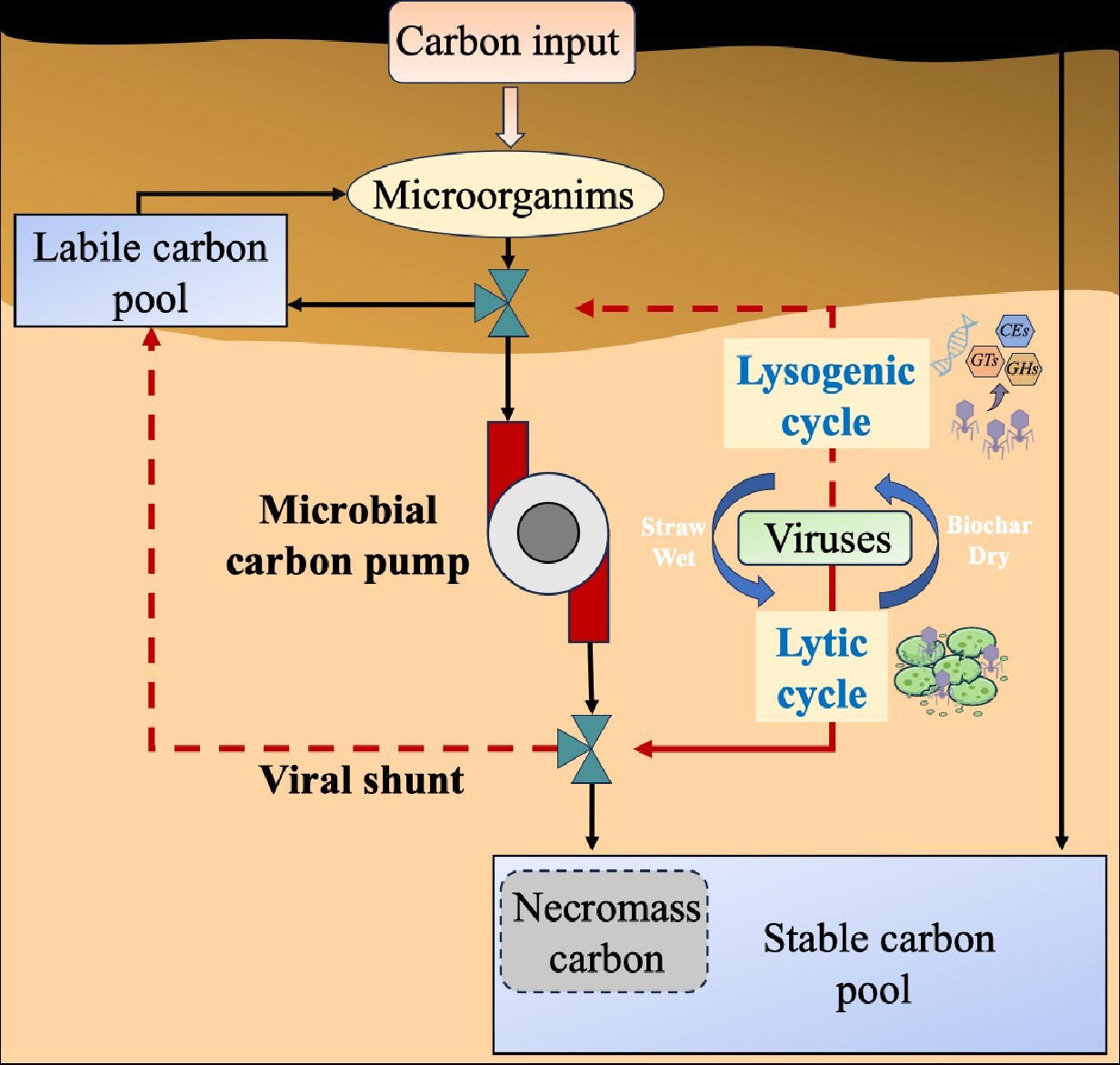
Conceptual model of the virus-mediated microbial carbon pump in soil (Image by WANG Yongfeng)
<関連情報>
- https://english.cas.cn/newsroom/research-news/202606/t20260603_1161065.shtml
- https://www.sciencedirect.com/science/article/pii/S2352186426002087
土壌ウイルスは、土壌改良剤と水分との相互作用下での溶解および代謝再プログラミングを通じて、微生物の死骸蓄積と関連している Soil viruses are associated with microbial necromass accrual through lysis and metabolic reprogramming under amendment-moisture interactions
Zhiyao Wang, Yilin Zou, Ninghui Xie, Chao Liang, Tida Ge, Rongjiu Shi, Yongfeng Wang, Xiaolong Liang
Environmental Technology & Innovation Available online 22 April 2026
DOI:https://doi.org/10.1016/j.eti.2026.104951
Highlights
- Virus–microbe interactions mediate SOC response to carbon and moisture treatment.
- Soil moisture filters viral lifestyles and modulates microbial necromass dynamics.
- Straw under drought enriches lytic viruses and AMGs, boosting SOC accumulation.
- Viral AMGs enhance host carbon fixation under high-carbon, low-moisture stress.
- Viruses act as dual regulators of the microbial carbon pump in agroecosystems.
Abstract
Soil viruses are emerging as key regulators of microbial metabolism and carbon stabilization, yet their roles in mediating the interactive effects of organic amendments and moisture availability remain poorly understood. Here, we examined how soil microbial and viral communities, their functional potential, and bacterial–viral networks mediate soil organic carbon (SOC) accumulation in response to carbon amendments under contrasting moisture regimes. The interplay between carbon amendments and moisture levels distinctly shaped the composition and interactive dynamics of the bacterial and viral communities. Straw amendment enriched copiotrophic Bacteroidota and stimulated lytic viral reproduction, concurrently increasing the abundance of auxiliary metabolic genes (AMGs) linked to carbon fixation. In contrast, biochar amendment favored oligotrophic Acidobacteriota and stimulated lysogenic viral activity. Drought further drove a shift toward lysogenic cycles across treatments. The consistent associations between virus and bacterial communities were evidenced by a significant negative correlation between viral and bacterial α-diversity. Crucially, life-history strategy analysis of the viral community revealed that enhanced lytic activity was positively correlated with microbial necromass and SOC accumulation, implicating viral-induced host turnover in carbon stabilization. Both viral lysis and AMG-mediated metabolic reprogramming of hosts acted synergistically to enhance necromass accrual. Together, these findings identify virus–microbe interactions as critical biotic mechanisms governing SOC stabilization. This work contributes to the advancement of the microbial carbon pump framework through the integration of viral ecology, thereby providing mechanistic insights for the management of soil carbon in the context of virus-related processes.