2026-06-11 東京科学大学
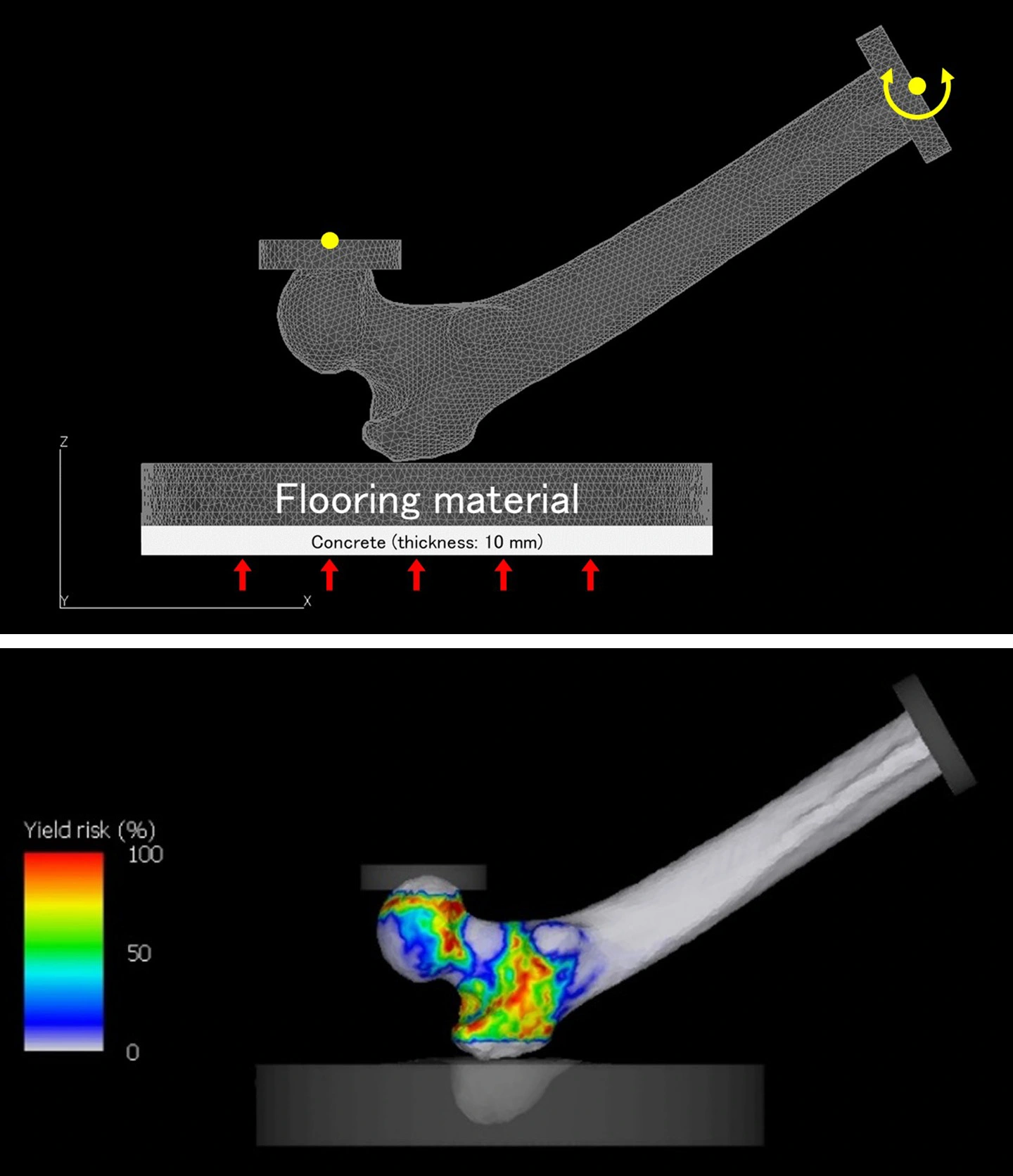
図. 本研究の概要
実際に大腿骨近位部骨折を受傷した日本人高齢女性患者の大腿骨CTデータと、各種床材の物理特性を組み合わせることで、転倒時の衝撃を再現した動的シミュレーションをデジタル上で実施できる有限要素モデルを開発しました。このバイオメカニクス解析モデルを用いて、転倒時の衝撃に応じて変形する独自構造を有する床材『ころやわ®』(22 mm厚、株式会社Magic Shields)が、高齢者の転倒による大腿骨近位部骨折の予防に有効であることを科学的に実証しました。(Oh Y, et al., Biocybernetics and Biomedical Engineering, 2026より転載. CC BY 4.0)
<関連情報>
- https://www.isct.ac.jp/ja/news/iwy5yihdch65
- https://www.sciencedirect.com/science/article/pii/S020852162600032X
脆弱性股関節骨折予防のための衝撃吸収床の有効性を評価するためのCTベースの有限要素モデルの開発:日本の超高齢社会における産官学連携 Development of a CT-based finite element model to evaluate the efficacy of shock-absorbing floors for fragility hip fracture prevention: An industry–government–academia partnership in Japan’s super-aging society
Yoto Oh, Kouhei Yamamoto, Atsushi Okawa, Takumi Kaku, Satoru Egawa, Toshitaka Yoshii
Biocybernetics and Biomedical Engineering Available online: 8 May 2026
DOI:https://doi.org/10.1016/j.bbe.2026.04.001
Highlights
- High medical costs due to fragility hip fractures are a global concern.
- Evidence for shock-absorbing mats in hip fracture prevention remains insufficient.
- A biomechanical model utilizing biometric data was developed.
- The model assessed the efficacy of shock-absorbing floors for fracture prevention.
- A novel mechanical metamaterial flooring material showed high clinical potential.
Abstract
In aging societies, the high medical and nursing care costs associated with fragility hip fractures among the elderly have become a global concern. Shock-absorbing mats are sometimes used as an alternative to hip protectors; however, scientific evidence regarding their efficacy in preventing hip fractures remains insufficient. Furthermore, their low stiffness can compromise stability during movement and gait. In Japan, a super-aging society, a novel mechanical metamaterial flooring material (MM-floor) has been developed to balance stability with shock absorption through its unique structural design, and it is expected to be adopted for government-led fragility fracture prevention initiatives. This study constructed a CT-based finite element (CT/FE) model to evaluate the efficacy of three flooring materials: a 2-mm vinyl sheet, a 40-mm sponge mat, and the 22-mm MM-floor. Using CT DICOM data from an elderly Asian woman’s femur, we simulated a backward fall in which the greater trochanter impacts the floor. Static analysis identified a fracture threshold at a reaction force of 1,400 N. Dynamic analysis, replicating the impact energy of a fall, showed that peak reaction forces for both the sponge mat and MM-floor remained at 1,200 N, preserving bone geometry through elastic rebound. Conversely, the vinyl sheet resulted in the complete destruction of the proximal femur. Our CT/FE model demonstrated the clinical and economic potential of the novel MM-floor. Furthermore, this model enables rapid product optimization by evaluating arbitrary material properties without posing risks to human subjects or incurring excessive development costs.